It's surreal, and dismaying, to contrast this surveillance push with recent Western reporting about North Korea digital surveillance[0,1]. Dismaying, because it shows (IMO) how our societal dialogues are helplessly stuck in a rut of doublethink—using one set of language to describe what the DPRK is doing, and entirely different language for the things the EU bureaucracy is doing, though they're the same things.
There's no daylight between North Korea's "dystopian reality" [sic] of capturing random screenshots of user devices, and the EU's mandatory data retention concept.
> In North Korea, your phone secretly takes screenshots every 5 minutes for government surveillance
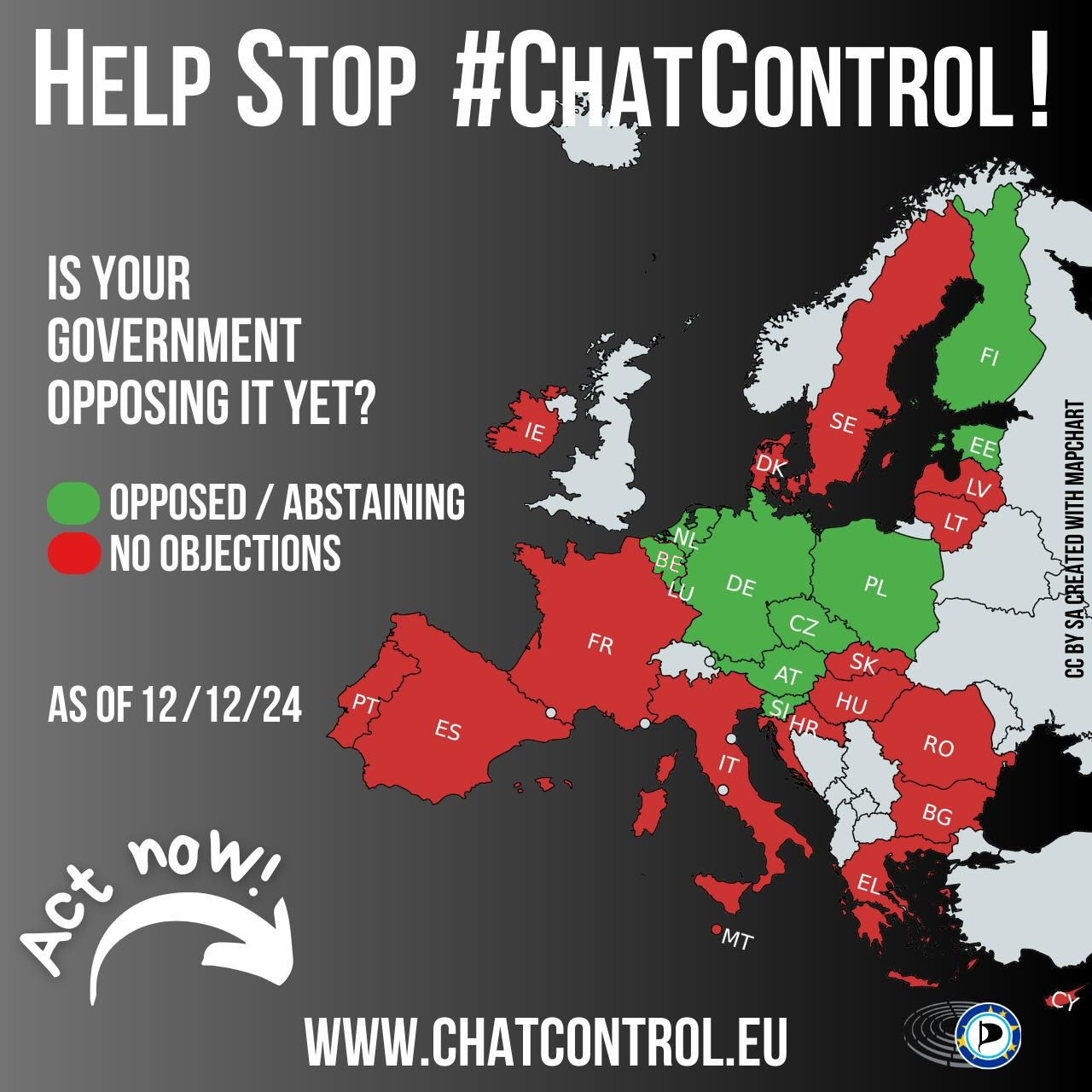
Context: Under the EU's Chat Control proposal, your private messages (Signal, WhatsApp etc) will be scanned by an on-device AI agent. The current debate is around scanning images and videos but the original proposals called for analyzing all text too (I wish I was joking).
You forgot to mention the best part, LEOs and MEPs and all militarily personnel would be exempt from this proposal thereby creating a two tier society where if you end up in the wrong tier, all your conversations will be watched by the government and in the other where you are free to say what you want.
Naturally. They know the agents will make mistakes and send your image or video to some underpaid cop somewhere along with all your details. It will be extortion galore.
I wish there was more potent ways to veto suggestions like this. Perhaps people should, in a democratic way, have the ability to ban representatives that are pushing these ideas, and many other, from politics for life.
But perhaps there's no way to make that "democratic".
Well, it's the core of democracy: the right of never ever voting for a given candidate again. What you are writing about is probably denying to some people the right of candidating themselves or even the right to vote. There are examples: one of them is Italy banning the fascist party after WW2 and the descendants of the royal family.
Excerpts of Provisions XII and XIII of the Constituton, easily googlable:
> It shall be forbidden to reorganise, under any form whatsoever, the dissolved Fascist party
> The members and descendants of the House of Savoy shall not be voters and may not hold public office or elected offices
I read that Germany banned a right wing party that recently won quite a large share of votes. I'm not sure about the extent of the ban and if it's a ban at all.
Even the original extreme proposal had wide support. The changes were offered only after Germany with Poland were against it IIRC. This is the state as of December 2024.
Just rephrase as "surveillance is bad when bad people do it and surveillance is good when our guys do it" to get the self-contradictory doublethink.
If you want nuance, say that surveillance harms a person's privacy, and mass surveillance harms _everyone's_ privacy. You can then think up scenarios where you deem privacy invasion acceptable - for example, if you have reasonable suspicion a crime is being commited by a specific person, but not to put fear into the hearts of citizens and to spy on and thwart any organised resistance to your grip on power. You might then conclude that you should not perform mass surveillance as it's in keeping with the totalitarian approach.
It's contradictory because it posits "X is Y and X is not-Y" simultaneously.
Also, I did not say surveillance was intrinsicly bad. I said it harms peoples' privacy, which it does, even if you think that harm is justified or beneficial, even if you think privacy itself is harmful and people should have less of it.
Distinction without difference: one would have to actually explain how surveillance is applied and leveraged differently across jurisdictions, allowing us to sub-divide into "good surveillance" and "bad surveillance", two different things.
Otherwise, we're talking about the inherit good-or-bad nature of surveillance as a whole and, thus, using the character of those applying it is irrelevant and contradictory.
The fact that many contradictory ideas are widely held or, at least, broadcast from the tallest proverbial hills, doesn't change the fact that they are contradictory. One thing all living generations seem to agree on is that politicians talk out of both sides of their mouth.
> one would have to actually explain how surveillance is applied and leveraged differently across jurisdictions, allowing us to sub-divide into "good surveillance" and "bad surveillance", two different things.
You mean like... having laws written down by elected leaders and then having judges who are accountable to the electorate to evaluate specific instances...?
I mean examples in-practice of such a system being used for anything other than mass surveillance of citizens which flouts their constitutional and human rights.
>having laws written down by elected leaders
The EU commission is not elected by public vote.
>judges who are accountable to the electorate
Judges are not elected by public vote.
edit: neither are the think tanks, NGOs, and array of well-paid experts who tend to both guide legislation and/or justify it to the public. This discussion can go in circles indefinitely as long as you continue to ignore reality and defer back to abstract principles and the _stated_ values & goals of the regime.
There are no cases where slavery is good, regardless of who does it or who it's done to. The same goes for genocide, murder, robbery and so on.
The ethic of reciprocity asks you to accept that "X harms Y" is the same as "Y harms X", while the totalitarian propaganda satirised in 1984 asks you to think of "them" and "us" and justifies immorality by claimimg it will benefit "us" and/or harm "them". The same theme ran through Animal Farm as well ("some animals are more equal than others").
It's still say it's doublethink to want to apply surveillance to some group of people but not others.
> There are no cases where slavery is good, regardless of who does it or who it's done to. The same goes for genocide, murder, robbery and so on.
Have you heard of prisons? We use a different word for it so as to not introduce the (obviously false) semantic "contradiction".
Perhaps if you want to say that forced labor is bad even after conviction, then let's say "kidnapping is bad when done by bad people, kidnapping is good when done by good people [to bad people]". Ta-da, you've invented prison.
True, though there is much emphasis placed on the link between language and thought in the book. As the parent comment suggests, there is a lot of tacit differentiation-without-distinction when it comes to issues of privacy, censorship, and governance.
I guess double-think is nothing more than an extreme form of cognitive dissonance being accepted by the masses, the interesting part is how this achieve in the book. Again, language & propaganda come first, then information control, followed by swift and brutal violence for dissidents.
And the EU ones will keep being proposals until they are implemented.
They absolutely shouldn't just be proposals. They should be scandals that make anyone involved have zero chance in future elections and unemployable anywhere near the political sector.
The last law that was deemed illegal (the data retention directive) took 8 years to be annulled by the courts. So the avenue of the courts is really not an option.
It's surreal and dismaying to see such a bogus comment at the top, especially since the BBC video about the North Korean phone is free of judgement, while they (and many other Western news) do report on Western surveillance critically, e.g. they called the Microsoft screenshots a "privacy nightmare" right in the headline...
Actually,reporting on NK or China's surveillance is usually because they are geopolitical adversaries not because they are dystopian.
So to think that the EU cares about freedom or privacy is to be naïve
The point is that reporting on NK's and China's surveillance of their own citizens is framed as dystopian. The framing only works if they claim that such surveillance is dystopian.
Of course elected representatives don't necessarily have the same opinions as news reporters. But you would expect consistency within the same publication
The system is designed to make you think you have a chance.
Ask the 30 people arrested in the UK everyday for their social media posts what they think of this ability to "fight back".
"In a despicable attack on the freedom of speech, a German right-wing journalist has been sentenced to seven months’ probation for mocking left-wing Interior Minister Nancy Faeser."
"The editor-in-chief of the news website Deutschland-Kurier was punished for sharing a satirical meme on his X account. The meme, which was posted by Bendels last February, shows Nancy Faeser holding up a sign, with the words: “I hate freedom of expression.”"
While I agree with the rest of your comment, it doesn't make sens to talk about “bureaucracy” here, the Commission isn't a “bureaucracy” (which means unelected civil servants), and more like a government (the commission is proposed by head of European states and approved by parliament).
That doesn't change anything to the problem though, Western democracies have been doing creepier and creepier stuff year after years when it comes to mass surveillance.
You really seem to be reaching there. I think we should face it - the EC does anti-democratic stuff, and is appointed, not elected, and far enough removed from democratic control that it really can’t be (and shouldn’t have ever been) considered ‘democratic’.
Having an actually elected body (the EU Parliament) and then not letting them initiate legislation is just a joke on top of that…
Like in pretty much every democratic government on the planet.
> Having an actually elected body (the EU Parliament) and then not letting them initiate legislation is just a joke on top of that…
It is because the head of states kept that power for themselves (as the European Council).
If this nightmare of a bill passes it will be:
- 1. because the state leaders pushed for it as members of the European Council.
- 2. Because ministers of the Interior of all member states approved it in the Interior meeting of the Council of the ministers of the EU (also called simply “Council”, it's a distinct body from the “European Council” which regroups the heads of states).
- 3. Because the European Parliament approved it.
In all cases it won't be the fault of “bureaucrates” but of elected politicians (like how the Patriot Act or DMCA were bipartisan pushes detrimental to everyone's freedom).
> Like in pretty much every democratic government on the planet
What? Both houses of the Federal Government of my country (I’m not in the EU), as well as the state/province level and the local level are elected, and I know that is the case for many others…
Why are you talking about House, the European Parliament is directly elected as well.
I'm talking about the government, which is a group of nominated ministers (nominated either by a prime minister or a president, and only the later is elected directly).
Take the US for instance: no citizen ever elected Rubio, Bessent, Hegseth, Bondi and co. as members of the Trump cabinet. The US citizens voted Trump, then he appointed them and Senate approved each of them after an individual hearing. That's exactly how it works for the European Commissioners too, except the nomination doesn't come from one president but the European Council, which is made of the 27th heads of states of the EU.
In Australia our cabinet is made up of elected Members of Parliament. They are appointed to their ministry but only our of the pool of elected MPs in the party or coalition with a majority.
Good to know, this is definitely an exception in World's democracies though.
(And if you checked the European Commissioners, most of them have been elected before and a handful were members of the Parliament right before their nomination. They are definitely politicians and not bureaucrats)
> While I agree with the rest of your comment, it doesn't make sens to talk about “bureaucracy” here, the Commission isn't a “bureaucracy” (which means unelected civil servants), and more like a government (the commission is proposed by head of European states and approved by parliament).
This is at best a difference of degrees. Neither the commissioners nor the civil servants have their names on a democratic ballot or are otherwise considered in any real way during the election process but both are indirectly chosen by the elected government. The question is how many degrees of separation do you need before the democratic elections no longer have an effect on the rulers chosen at the end - and the answer is probably not that many.
> Neither the commissioners nor the civil servants have their names on a democratic ballot or are otherwise considered in any real way during the election process
Neither is any minister in most democratic country. You don't get to vote for the Secretary of the Treasury or any member of the government directly in most systems. Presidential systems have an exception in the person of the president, who is personally elected, but everybody else is appointed and merely approved by the parliament.
In the European parliament, the EPP won the parliamentary elections last June, and they approved the nomination of the Von der Leyen Commission, like how the Starmer Cabinet got approved by the House after the Labour won the elections.
The real difference is that nobody really cares about the European parliamentary elections: in pretty much every country it works like some kind of intermediate election for national parties to assess their strength, and they don't really campaign as members of EPP or S&D and mostly as members of their own national body without any consideration for European politics. And that's quite a serious problem.
The EU has many institutional issues (most of them deriving from the fact that individual state leaders refuse to give more power to the EU), but the Commission members not being individually elected isn't one of them.
It's not surreal, just human nature. Most people are not guided by principles. It might not even be that, but some people purposely have bad intentions and gaslight objections, and most of the rest are not interested to object and simply can't be bothered as long as their basic needs are met. If the answer to Stasi like espionage of citizens is outrage, but otherwise not because you have nothing to hide, then I conclude most people are content with living in a cage, as long as it's made of gold.
You don't get it - in north korea is brutal dictatorship that oppresses their citizens. EU commission is fighting hate, discrimination, racism and disinformation. And protecting the children too.
You forgot "Freedom of speech" as well but only the speech that is allowed otherwise you end up with the cops at your doorstep like in the UK when you post the wrong thing on social media.
I think this is too serious issue to make such jokes.
Sadly this is their actual stance, and this is why everyone who opposes EU's overreaching policies are labeled as 'right-wing extremists'. In Germany they go as far as to try to ban these parties. It's an absurd repeat of history.
Such a law would in effect silence the voices who opposed the law, making way for even more totalitarian laws.
The situation in EU is incredibly sad and I'm not sure if it's possible to fight this.
They still mean something in serious discussions. If you find that media use seems to dilute the meaning of a term so as to be uselessly vague, consider the likelihood that it is intentional. (Very high, IMO.) The critical-thinking-not-allowed topics are especially interesting to pay attention to: who is served by devaluing the term?
I really feel like we'd all be better off if Manufacturing Consent [1] was required reading.
The media is complicit in pushing domestic and foreign policy, is selective in what it covers and how it covers it and intentionally uses very different language to describe the exact same thing (eg [2][3]).
I generally agree that what the DPRK does and what Europe (or the US) does isn't really that different. Dig a little deper and look at the role the West played in creating the DPRK and the intentional starving (ie economic sanctions) we enacted, just like in Iraq, Iran, Syria or Venezuela.
European (and US) history of the last century is the neoliberals siding with fascists to quash anything communist or communist adjacent (eg labor unions). Germany might've lost the war but Nazism won. Whatever you do, don't look too deeply into the background of Adolf Heusinger [4] who was made the Chairman of the NATO Military Committee.
Just to confirm, you believe the local media as perceived by their population (& by extension social media) has the same power to push back on policy in the DPRK as the EU?
>There's no daylight between North Korea's "dystopian reality" [sic] of capturing random screenshots of user devices, and the EU's mandatory data retention concept.
This is nihilistic BS and false equivalence.
EU commission's retraction can be challenged in the courts if it's not allowed.
> EU commission's retraction can be challenged in the courts if it's not allowed.
Take it from a gay American dinosaur: you cannot trust the courts to do the right thing. The court system of any country is the system of last resort to dealing with issues after they have caused harm or suffering, and by design they’ve been overloaded with grievances to make it harder to stop any institutional harms.
The right time to stop this sort of action is before it becomes law. Ideally, a society should be educated and inoculated against such harmful activity such that the mere mention of an idea of such a plan is enough to ruin one’s career, nevermind letting it make it to an actual proposal or committee.
Stop putting faith in a court system operated by the same entities making the rules. You’re effectively waiting until the last possible moment to stop something after it’s done harm, which is highly irresponsible at the very least and does nothing to prevent harms from happening in the first place.
> "Ideally, a society should be educated and inoculated against such harmful activity such that the mere mention of an idea of such a plan is enough to ruin one’s career"
Well said.
It's a weak and stagnant variant of democracy, where people say (to paraphrase): it doesn't matter what the people think, or say, or believe; or how their elected representatives vote; because you can just count on the courts (or some other force external-to-democracy) to clean up and fix everything. That's not democracy. That's shirking the hard parts of civic participatory democracy—offloading the burden onto a small group of elites who aren't meant to be morally load-bearing.
You've *failed* at liberal democracy if you've reached the point where your popularly-elected representatives are floating the suggestion of North Korean-style panopticons. (Or anything else as antithetical to core human rights).
Liberal democracy, if it should exist, is a zeitgeist of strongly-held shared values—not (only) a set of legal technicalities codified in a document somewhere.
Yes and that even seems to be missing the key issue - if a system's legislative body is hostile to basic tenants of liberal democracy then expecting the courts to act as a protective buffer is at best a stalling tactic to delay the inevitable by a few years. It is almost pointless fighting once that sort of law gets in, the powers that be think mass spying is OK and are committed to finding a way. The courts can't protect people from that sort of pressure, the only way to resist is to have people in power who think mass spying is bad. The US failed that test and it looks like Europe will too - very distressing for the prospects of the liberal project.
But you say 'if it's not allowed', but not allowed by whom?
The courts aren't some kind of magic guarantors of justice and order, and something isn't okay just because the courts approve it. If this somehow is tolerated by the courts, the fact that we have them is irrelevant.
It's the policy itself that determines whether we are like North Korea.
"But you say 'if it's not allowed', but not allowed by whom?"
Not allowed by EU law obviously. Role of courts (in general) is interpreting law and thus deciding how said laws apply case by case. Law in EU flows down from EU treaties that where negotiated and signed by member countries. The big ones (treaties) needed also be "ratified" by country wide referenda.
My interpretation of parent comment is that, we shouldn't be just "themwashing" these powers, and start placing them under technical scrutiny more often.
So laws are made by people, sometimes retired people, sometimes people.
So it's just another thing allowed by a person. Law isn't something magical with capability to make something not okay okay. Law is just someone allowing or forbidding something, with this having been incorporated into a sort of system.
I don't know exactly what you mean, since we have a representative democracy and since the governments enter the treaties and have strong influence over many parliaments it's really is very person focused in the end, even though it really shouldn't be.
A sensible world would have lots of referendums with the general public approving or disapproving of parliamentary decisions, à la Switzerland, but that is not the world we live in.
I do not feel heartened by this sentence, even though I should be. We're choosing from a pre-curated menu rather than truly "hiring" representatives. The real power lies with party gatekeepers, donors, and institutional barriers that determine who even makes it onto the ballot, not with voters making the final selection. It's more like being asked to pick your favorite from two restaurants that a food critic already chose for you, rather than having genuine choice over where to eat.
and it's not incredibly practical. Instead those sit at the head of institutions, whether political parties, governments, etc. have real power.
It's a bit like saying 'so make your own Facebook', but that's pretty useless if it's a response to someone who feel that some big social media company is influencing public discourse and harming proponents of certain ideas.
You can't make your own Facebook, or organize a political party other than in response to slow phenomena, and here we're talking about something has until recently been seen as literally illegal-- against the founding principles of the EU, so this is a huge, sudden change which people have no chance of resisting in a representative system.
You are basically chosen by parties and other entrenched organizations. New parties are very unusual.
However, none of that really matters. Democracy, laws, etc. don't make this kind of anti-privacy policy more legitimate. If you create a STASI, it doesn't matter if you do so democratically, and that really is what we are talking about.
With software on your phones controlled by others going through your stuff you have a beyond-STASI-surveillance level.
The previous proposals ran into basic human rights issues. Changing laws related to those tends to be a lot harder than just passing jet another surveillance bill. Of course it still isn't perfect since those can be bypassed by "restricting" the use of the data to specific cases and then just ignoring the restrictions once the systems are in place.
Sure, but until the courts handle this, the damage is already done. Until that point, laws can be changed.
The problem is not that the EU doesn't have checks and balances, the problem is that politicians are willing to offend common decency in the first place and drive the erosion of civil rights.
I wouldn't bet on that. Zensursula is already a well known meme. Doesn't change the chance of her or anyone else in the commission facing any consequences.
I always figured that the president of the European Commission is a member of the European Commission but I wasn’t 100% sure if that is “technically” the case. I did some research and The list of Members of the von der Leyen Commission¹ clarifies that the president – along with the vice-presidents – are included among the 27 members of the “College of Commissioners”.
The ECHR and the EU charter have loopholes that basically say "unless stipulated by law and being necessary in a democratic society" or similar. This is why we already have extremely intimate surveillance by secret police laundered with some supposed petty crime as excuse.
The current regime demands too much bureaucracy and too many employees to be rolled out broadly, hence this push to do what they're already doing but on a much larger scale and just store the data until they want it. From the perspective of politicians it's already something that's being done, e.g. in the US surveillance programs and everyday policing and software from large US corporations and so on. They think the resistance from their subjects is infantile and stupid.


There's no daylight between North Korea's "dystopian reality" [sic] of capturing random screenshots of user devices, and the EU's mandatory data retention concept.
[0] https://www.techspot.com/news/108156-north-korean-smartphone... ("In North Korea, your phone secretly takes screenshots every 5 minutes for government surveillance")
[1] https://www.bbc.com/news/videos/cewd82p09l0o ("Inside a phone smuggled out of North Korea")