Not just fiction, but Russian technical books were also memorable from my childhood in India. Many here would remember their struggles with I.E.Irodov's Problems in General Physics [1] as much as stories of Chuk and Gek [2], or Misha.
I'm studying for the JEE and Yes! Irodov is a beautiful book. That, along with Krotov, tells me Russia must have had an excellent program, with their Physics books from the above, their Chemistry books from Landau, and their Math Circles.
Lev Landau was a Physicist. And I really liked his book on Quantum Mechanics.
Landau's books[0] are very famous among advanced undergrads and grad students of Physics in India.
Landau also measured the genius of his contemporaries[1]. He gave himself a 1.5, and 1 to Schrodinger, Satyen Bose, etc. Eisnstein was 0.5. (Lower the better)
A low cost Indian publisher named "Arihant Publications" has published Irodov's (and others) books under "Classic Texts Series"; all available on Amazon India.
Irodov has a reputation for being difficult. I remember that if someone could solve a problem from that book, they would be considered especially bright.
However I also remember trying the book and after some failed starts really getting into it and it became one of my favorite books. I believe the difficulty was because the book was purely problems, there was almost no context of theory. But the problems were very well designed and solving them was a joy.
I was lucky to get hold of 70 of these books in absolute mint condition (except for rusted stapler pins) last year after years of futile search in secondhand markets all across India. My dad, a book hoarder extraordinaire in his own right, managed to connect with a retired journalist who apparently stumbled upon them in Nepal and bought them at like less than a dollar a kilo or something!
https://www.arvindguptatoys.com/ probably has the largest collection of many of these books in English and other Indian languages. There are tons of children’s books from other countries too.
Holy smokes this is awesome! Kannada being my mother tongue I can read (more or less ;-)) Telugu! BTW do you have Stories from Russian History? I had its Kannada edition as a child; been searching for it for a while. The book title (in Kannada) is "Russian Itihasadinda Kathegalu".
Yes indeed! Amazing stories and illustrations. Have read this book end to end probably a dozen times as a kid :) The headings in this book had a Telugu font I'd never seen used anywhere else.
It is relatively easy to find if you search in the right places. Have seen copies of it floating around in many second hand shops. I'm pretty sure you can get this in Lenin Centre, Vijayawada. I can speak to my dad and see if he can help. You can ping me at xhreeha.replace.x.with.s@gmail.com
Any chance you are from Mysore? I grew up in Mysore and these books were always on sale in the Town Hall building next to the city bus stand. I would go there with my mom and spend HOURS picking books while she did her other shopping.
Though I didn't grow up in Mysore I studied engineering there; I fondly recall those 4 years of my life. I didn't know about Town Hall book sale :-(. Fabulous city Mysore, it has managed to retain its original self despite all these years.
Those looking to buy Soviet era books in Mumbai, check out People's Book Store in Fort area (Google maps- https://goo.gl/maps/pJd7ve2g68D8AXsK7). Behind racks of Marx and Che Guevara are stashed quite some rare books.
I distinctly remember seeing the cover image book (Adventures of Denis). Visited sometime in late 2018.
I remember these short 20-30 page math books written for 6th-8th grade students by prominent Soviet mathematicians. Extremely clear exposition. About 30 years later, I still remember the contents of the book on logarithms, which gave geometric interpretation of log as the area under the curve of 1/x, and used that to show why log must satisfy properties such as log(ab) = log(a) + log(b). As a 12 year old, my mind was blown away and I read all such books that I could find, which lead to a lifelong passion for mathematics.
I highly doubt it. They are problem books and aren’t aimed at middle school kids. My guess would be the [1] Science for everyone pocket books. They fit the description but definitely have more than 20-30 pages.
Ah yes the little mathematics library :) I had a book or two from this series but never really got into them. Was more into Perelman's books on puzzles and riddles at that age. And speaking of pocket science books, my favorite is [1] 'Straight Lines and Curves'. Accessible to high schoolers with quirky illustrations and introduces many interesting concepts.
The books by Soviet authors always seemed so much less verbose than those from the West. I particularly appreciated this, as I had - and have - poor English ability (like many other Indians), but was nevertheless forced into an exclusively English based education (also like many other Indians).
There are gems like Spivak from the other side, but I find it much rarer. Even papers are annoyingly verbose - almost as if to compensate for general lack of novelty.
First, I find it hard to believe that someone who can correctly construct a phrase like "almost as if to compensate for general lack of novelty" to have poor English. Or perhaps your definition of "poor" is different than my own.
Second, why not just ignore the verbiage you didn't want or need? It's easier to remove exposition if you don't want it than to add it in if its missing!
if someone would mark all the "important" bits in red, I could.
alas, they don't, and drone on and on and on with smattering of important bits thrown in.
for instance, Thomas & Finney's book is what... 2000 pages ? In comparison, Piskunov was something like 200-300 pages IIRC.
btw phrase usage is not "good" english - it's in fact an easy tactic to get around it. this is a very obvious in the outputs of Indian state/academia, esp. in the humanities - lots of fancy sounding words/phrases, but very often, zero actual knowledge. some of the judgments of the indian courts, will even make you weep... but i digress.
personally, non-generic non-templated emails still take a lot of effort and constant second-guessing.
(this took ~5-10m to write, and probably still has grammatical errors and semantics issues).
My senior year quantum prof was a Landau student, and he was so terse and inscrutable - it was an awful class. Given the man's combination of thick Russian accent, lisp, and poor English, a bit of redundancy in his delivery would have helped!
Growing up in India, I had quite a few of these Soviet gems on my bookstand. The only thing I had that originated from the West were a pair of Levi jeans. I was shocked to find out that a system that could make those jeans would win against one that made those books. In the early 2000s I was working in SV and repeated this remark to a Russian colleague. He told me of course the system that made the jeans is superior - he did not get his first pair of jeans till he got to the US and the trousers that he wore in Russia were absolutely horrible when compared to the jeans. Jeans to him were a marvel of engineering. The fact that a system could produce affordable jeans that would last for years, which people could buy whenever they wanted by strolling into their neighborhood shop was a much bigger achievement than state sponsored STEM books
I grew up with plenty of very good Soviet books and without Levi jeans.
The jeans were a status symbol, almost impossible to find and the price was 1-2-3 salaries of an engineer, teacher or doctor.
Now that I have more access to jeans but having troubles finding good books for my kids, I would chose the books over the jeans. But I wouldn't go back to USSR.
It's also a bit a false narrative that systems win or lose: the USSR people decided they wanted to change, and they changed. The system they have now is not exactly the American system, you'll agree, and they're not dead: so what "won" ? KGB-controlled non-communist autocracy, or Liberal Capitalism ? I'd say the first :)
Now what inspire copy from other country, maybe your definition of winning, is probably the second one. But it didn't have to be at the fall of the wall, or the USSR. The problem was always the USSR, but the solution will probably rarely be the US.
Some of the most awesome books I fondly remember from my childhood are Soviet ones. One awesome thing about those books were that they were translated to regional language and were printed/typeset in equally high quality papers and hard bound as the original. One reason most comments here are able to relate with the post is because those books were accessible to them in their mother tongue. Russia/India did a fabulous job in translating those books to Indian languages and still maintain high quality print and typeset. Unlike now in those days English language was not accessible so all the education and learning was in the child's mother tongue.
Physics for Entertainment -- Yakov Perelman [1] is one such book.
I remember having a hard-bound Bengali translation of Russian folk tales with characters like Baba Yaga, names like Alynoushka/Ivanoushka and houses that had feet and turned on them. Considering how rich the Bengali language is, it was a match made in heaven. I found a nice pdf of 16 Russian folk tales for my daughter - each quite detailed - she loves them.
There is a great "origin story" for "Mathematics: Its content, methods and meaning". Kolmogorov initially read a great deal of mathematics by reading encylopedias like one by Brockhaus and Efron. ( see, e.g. Tikhomirov "The life and work of Andrei Nikolaevich Kolmogorov", 1988 Russ. Math. Surv. 43 1, Page 8) This contributed to his great breadth of knowledge in mathematics.
He later felt that the encylopedia articles were too brief, and must be somewhat more elaborate. He spent a great deal of effort in "The Great Soviet Encyclopedia", and wrote some classic articles like the one on "Probability Theory". Later, with other distinguished mathematicians like Ladyzhenskaya and Sobolev, he formulated the great tri-part volume "Mathematics: Its content, methods and meaning". Great for a budding researcher in mathematics.
A modern successor to this kind of effort is "The Princeton Companion to Mathematics", which is an encylopedia of mathematics for the mathematician.
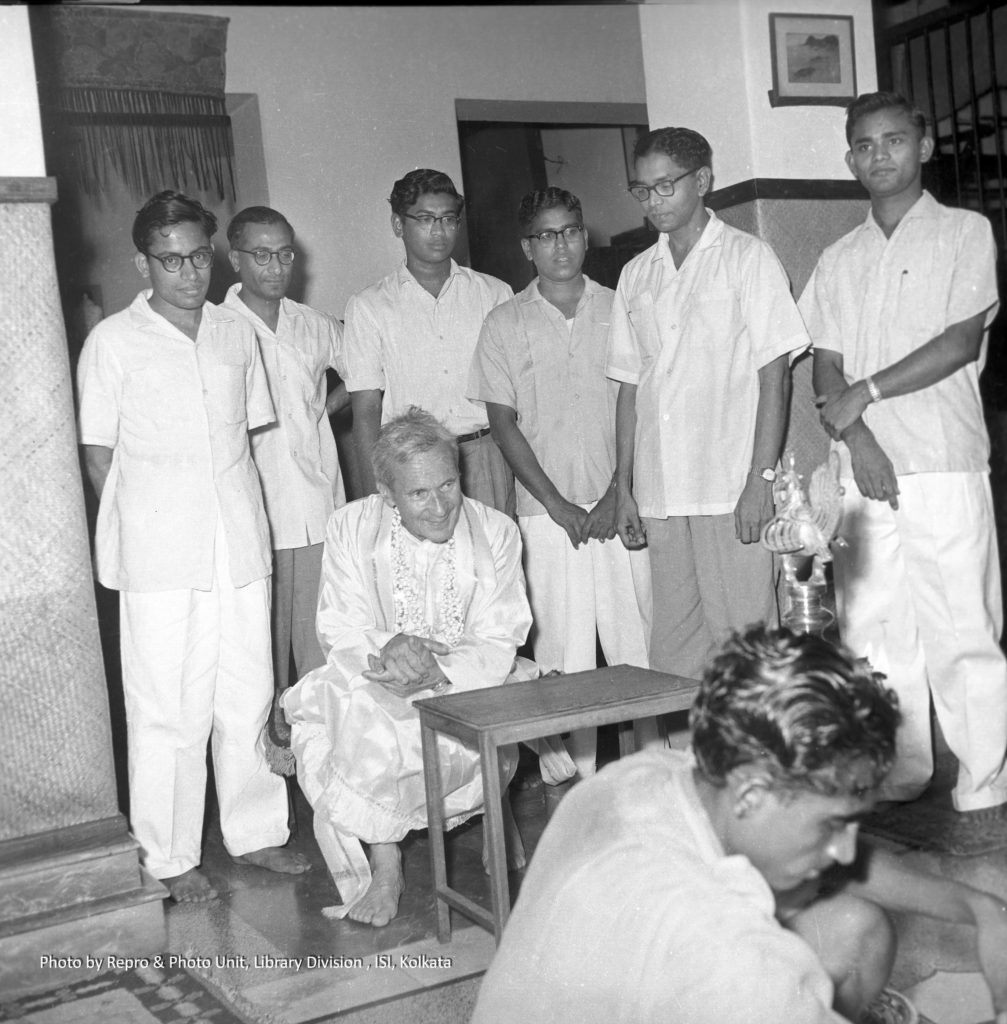
Another historical anecdote is Kolmogorov's famous visit to India. I have heard Soviet mathematicians who were students at that time, asking excitedly about his visit, like did he have to sit on top of trains? Kolmogorov laughed and said that the trains were quite comfortable. An amusing pic has Kolmogorov in dhoti and kurta, with the Indian statisticians standing around him with pants and shirts: [1]
India and USSR had deep ties during the cold war. The US was pro Pakistan, which naturally pushed India to ally with Soviet. This cultural exchange is obvious.
I wouldn't say there were deep ties, but there certainly were some. Only older people remember those ties now. You will find comments by such people on Youtube clips of old Hindustani songs. Not just Russia, they come from other ex-Soviet states as well. I've talked to some younger Russians, and they can sometimes recognize these tunes, but have no idea about their origin.
the cultural exchange is actually non-existent - indians know next to nothing about Russia. the deep-ties you speak of were/are mostly restricted to state, party and intellectual capture by the KGB (and the CIA).
indian elites, on the other hand, despite there announced loyalties, have always been and will remain anglo-saxon vassals - and so will the indian state and people. indeed, even after 70 odd years of so-called independence, one is still forbidden from using Indian languages in the higher Indian courts, manned by the elite brown "anglo" feudals.
You sure the reason they still use English is due to being "Anglo-Saxon vassals". And not, y'know, the lack of a common Indian language that everyone is happy to use? For example:
"The Indian constitution, in 1950, declared Hindi in Devanagari script to be the official language of the union. Unless Parliament decided otherwise, the use of English for official purposes was to cease 15 years after the constitution came into effect, i.e., on 26 January 1965. The prospect of the changeover, however, led to much alarm in the non-Hindi-speaking areas of India, especially Dravidian-speaking states whose languages were not related to Hindi at all. As a result, Parliament enacted the Official Languages Act, 1963, which provided for the continued use of English for official purposes along with Hindi, even after 1965."[1]
Moreover you aren't even right that all higher courts in India operate in English.
"in many high courts, there is, with consent from the president, allowance of the optional use of Hindi. Such proposals have been successful in the states of Rajasthan, Madhya Pradesh, Uttar Pradesh, and Bihar."[2]
Indian elites have evolved over the millennia so categorizing them as forever being Anglo Saxon vessels seems to be both improbable and a useless assertion to make.
Fun fact: Dennis Dragunskiy, the hero of his father's stories, is a very real person, now in his late 60s, has turned to literature too, and is very active on Facebook writing short stories. He is one of the most popular people in the russian Facebook.
I remember traveling exhibitions from Navkarnataka Publications which used to be fascinating. Mostly Russian books along with very nationalist (in the good sense) literature. Ukrainian Folk Tales and many Russian math books. I remember buying a book on astronomy - quite possibly of Soviet origin - at one of these exhibitions, which introduced me to the delights of the sky.
I moved to the US and I cannot still understand this. House == clean, outdoors == dirty. Why keep the shoes on? I had a Chinese born landlord who told me that they also take their shoes off. Not to mention that I think takin shoes off when entering a house is expected in the Japanese culture as well.
Strange. I was raised to take my shoes off, and it feels commonplace to me to take your shoes off when you go into someone else’s place. Perhaps this is a regional thing.
Yes, Asian and Eastern cultures have this. To me, people walking into my house without taking the shoes off will always be completely wild. Definitely not a Soviet thing exclusively. Unless it's furniture delivery or some sort of maintenance/construction. I expect to clean after that anyway.
I would recommend Sergei Mihkalkhov's Disobedience Holiday and other children's stories. Soviet children's writing was very high quality and at par with what was being written in the west. Perhaps the Soviet ones had better art too and were well printed and bound.
Even the lush Soviet inks had a peculiarly inviting smell and eye-popping colour.
Yep. Grew up with them, and it was these books that sustained my interest and imagination in science.
I still remember a hard-bound, deep blue coloured (roughly) notebook sized book that had these amazing DIY projects for space, including a rover etc. I don't think I could ever make the more complicated ones- they required woodwork etc which I simply didn't have access to as a child. But they helped me dream and develop an interest in making stuff of my own, and they are one of the reasons why I still love tinkering.
I wish I could get hold of that book once again, but I can't even recall it's name!
The obvious passion for well-written, physical books made me smile. A nice read for a Sunday morning, so thanks.
Here in the US, we’re obsessed with copyright and stamping away physical books; and replacing them with more ephemeral digital “copies” (a huge f** you to Amazon).
As a side note: I remember reading that the Soviet Union and India enjoyed a good relationship back in the 1970s and onward. I always wondered what sort of impact it had on India.
Another tangent: Some of these books look amazing for someone trying to revive his passion for math, decades after college.
>Some of these books look amazing for someone trying to revive his passion for math, decades after college.
If you have never read any of the Soviet era Science books, you absolutely should get hold of some and go through them. They were succinct and to the point with the density of information being quite high. By comparison, most modern text books are so verbose and sometimes dumbed down that it becomes quite a chore to sift the wheat from the chaff.
Dover publications has some good ones starting with Mathematics: Its Contents, Methods and Meaning by Kolmogorov et.al. There is also the I.M.Gelfand series; Functions and Graphs, The Method of Coordinates, Algebra, Trigonometry etc.
If you're looking for Russian-language stuff and happen to come to Russia (mainly Moscow and SPb), you can buy crates of books from the 60s-80s for handfuls of bucks—they aren't highly valued since everybody had them in the family.
Dunno about international shipping, though—we don't usually have experience with that. Receiving maybe, sending not so much.
I have faint memories of reading Misha comics in English when I had just about started reading. Do remember enjoying it along with other Indian content in Hindi like Champak/Chandamama but unlike these we maybe stopped getting supplies of these later with the USSR implosion as I don't remember coming across them later.
For our engagement , my new fiancée gave me a complete set of the Landau-Lifschitz course and I gave her a diamond ring. Both gifts were clear, glittering , timeless.
I was a physics student in Italy in the early '00 and math and physics MIR books in Italian were beginning to be hard to find as newer editions were coming out. I remember the feeling of pride when I snagged a copy of a book on calculus of variations for a couple of euros. I still think the graphic design was amazing [0].
Obviously Landau-Lifshitz was also a must read (though it was starting to show its age in some subjects). I also recently found a MIR Russian translation of Gardner in a market in Kyiv (illustrated hardcover for under $2...).
One thing I loved about visiting relatives in India in the 70s was the exciting soviet influence which was not available in the west. "Cosmonauts visit Delhi" screamed a newspaper headline that made me beg to go visit Delhi. I've never forgotten that.
As an adult, I of course realized the Soviet Union was only interesting because I wasn't getting a full picture, but that is true of a lot of things I suppose.
>"As an adult, I of course realized the Soviet Union was only interesting because I wasn't getting a full picture"
If you get "full picture" it is still interesting. They've done some horrible things, some meh thing and some absolutely amazing and beautiful things. Proportions of those of course depends on time period.
It is then up to the individual to realize what they see, how and what they can have from looking at it. If one wants to find crap they'll find it everywhere and the opposite.
P L Deshpande is one of the best author in Marathi literature. For me the best part of learning Marathi, is reading his literature. When reading his book, you will be rolling on the floor while laughing and then suddenly he will touch your heart such a way that you start crying. What a roller coaster ride !
His real potential was observing individual's traits/characterstics and waving story around them. Sadly I belive it is very very difficult to translate his work as there are lot of cultural references in his writing.
If you do learn it, you might enjoy reading the poetry of Madhav Julian. He was a real lover of Marathi, but also brought into his work Pharsi and English elements which might be familiar to you.
I loved a hardcover book as a child called dada ka chashma. I remembered that book seemed to be from Soviet union. I just searched for it and it's called grandpa's glasses by Georgi Yurmin.
Ah! This brings so many memories. My grandmother bought me some of these when I was a kid and they were my all time favorites. There used to be book-fairs even in smaller towns like mine and bought tons of them. (All in my native tongue, Kannada)
What a sweetly nostalgic trip back in time through these comments. Misha, Irodov and many other Russian children books are such a treasured time from my childhood.
If anyone has any scanned copies of Misha, I’d be very grateful if you can share please!
I remember my mom reading these for me, and I'd go "what kind of a name is Ilya?" And years later at University our elective humanities professor explained in detail how Soviet and American propaganda worked in the older days and that was when I truly understood
In Vietnam, at one time, there was a very popular Russian children book called "Old Man Khottabych". Aside from the typical communist teachings and propaganda, the plot is actually interesting and the book is a lot of fun to read.
I had gotten hold of a few Misha books. I think they were bilingual. As a result I could read Cyrillic alphabet and Russian to some extent. Not any more alas.
Reading Russian fairy tales is one of the fondest memories of my childhood. So many beautiful, lively pictures, and unique stories made my slow and hot Indian afternoons enjoyable.
Such books had very good Bengali translations printed on very expensive papers with expensive ink which Indian publishers could only dream of even 10 years ago.
My state (WB, IN) was ruled by Communists for 34 years and we got book printed in Russia in extremely low prices (subsided by USSR).
Here's some pictures from one of such a book sitting in my shelf right now-
Here, in Ukraine, we usually try get rid of the soviet legacy and I’ve never heard about anybody collecting soviet books. They are filled with communist propaganda and are not fun to read.
The thing is, they were printed at a massive scale (up to 100s of thousands), which doesn’t help them in being a valuable collectible.
By the way, there is a website where soviet children books translated to ukrainian are published with illustrations in case anybody is interested in such things:
There's lots of very negative points rightly to be made about the Soviet Union, but lack of investment in high quality childrens books is definitely not one of them.
These things were heavily subsidised, so cheap even by USSR standards.
I've got a few Latvian language ones I'm particularly fond of. A compilation of Baron von Münchhausen stories for example - one of them the etymological source of the word "bootstrapping", or Astrid Lindgren's Ronja the robber's daughter.
Most Latvians I know, especially the ones of Latvian culture extraction, have very good reasons not to enjoy their memories of the USSR occupation, but childrens books in particular seem to be exempt. Within the boundaries the USSR set, there was an incredibly rich and high quality production. A sharp contrast unfortunately to a lot of what is currently happening in that space.
It's not everybody in Ukraine that is so froth-mouthed with their hate for USSR/Russia that they would get rid of quality books just because it's 'Soviet legacy'. Throwing the baby with the badwater spites yourself, not USSR.
To my recollection, the former was a post-scarcity utopia that, like in most children's literature, east or west, didn't go too deep into the details (with the main moral of the story being 'don't be a dick to people'). I don't think it was particularly political.


[1]: https://archive.org/details/IrodovProblemsInGeneralPhysics
[2]: https://en.wikipedia.org/wiki/Chuk_and_Gek