Majority means > 50%. Perhaps you meant plurality.
Regardless, US presidential elections do not depend on getting a majority or even a plurality of popular votes, but rather on a majority of electoral votes. And Trump did not get a majority of popular votes as claimed.
This being HN, the fact-check seemed appropriate and I stand by it.
> What law are they breaking by forcefully extracting a criminal?
"All Members shall refrain in their international relations from the threat or use of force against the territorial integrity or political independence of any state, or in any other manner inconsistent with the Purposes of the United Nations."
This is not an answer to your question, but one issue is that if you write about some niche sort of thing (as you do, on a self-hosted blog) that no one else is really writing about, the LLM will take it as a sole source on the topic and serve up its take almost word for word.
That's clearly plagiarism, but it's also interesting to me as there's really no way the user who's querying their fav. ai chatbot if the answer has truthiness.
I don't see how this is different from the classic citogenesis process; no AI needed. If a novel claim is of sufficient interest, then someone will end up actually doing proper research and debunking of it, probably having fun and getting some internet fame.
Agreed, it's definitely a problem, but I'm just saying that it's the basic problem of "people sometimes say bullshit that other people take at face value". It's not a technical problem. The most relevant approach to analyze this is probably https://en.wikipedia.org/wiki/Truth-default_theory
Are you suggesting that the AI chatbot have this built-in? Because the chances that I, an amateur who is writing about a subject out of passion, have gotten something wrong would approach 1 in most circumstances, and the ask that the person receiving the now recycled information will perform these checks every time they query an AI chatbot would be 0.
I have a degree in fine art painting and drawing and that's not correct for oil painting. We would first put on a layer of earth tones, and work from the shadows to the mid tones. Once you got the form correct, you would work on things like adding color, details, and highlights.
In no way would you start with saturated colors. One, they're very expensive, so why would you apply them, just for most to be painted over? Secondly, the more saturated (strong) a color is, the harder it is to paint over. Try painting over a wall painted bright red with literally anything. Paint it over in blue and your blue turns brown. Paint it in yellow and you'll just get red again. That's why we (still) employ a very opaque, white paint to the canvas. Oil paint also becomes more transparent over time, so getting the form right with the earth tone underpainting is crucial for the painting to last hundreds of years.
Perhaps you're thinking of fresco painting? Then, the pigments are added to the medium (plaster) initially, and only very subtle highlights are added afterwards (if at all). This is a very, very difficult technique, and illusions like highlight and shadow are hard to pull off. But the painting over was frowned upon, because it doesn't last nearly as long as the embedded pigment in the plaster (and certainly not after cleaning/restoration). But adding highlight/shadow to a sculpture seems like not the play, as the 3D-ness of a sculpture would imply it brings its own to the table.
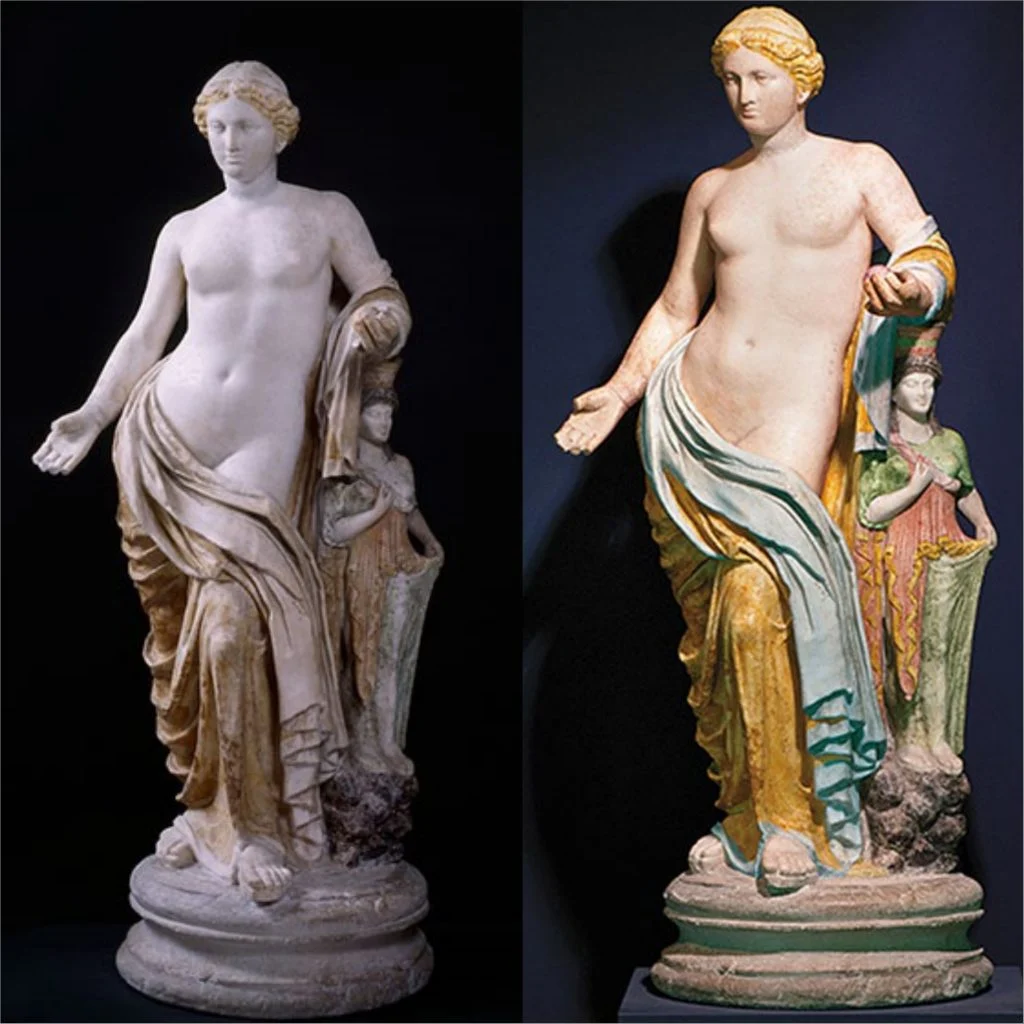
Makes more sense just to paint the sculptures the color you wanted them painted, like the (in comparison very contemporary) bust of Nefertiti in the article, which looks excellent. No need for highlight/shadow. I could only see that needed in the face, which would look and act much like makeup.
friendly knuckle cracking I wouldn't normally do this, but I did say I'd die on this hill. I'm a tenured professor of art at a major research university. Firstly, maybe I shouldn't have said "saturated," but then again, you wouldn't argue that your earth tones, for example Yellow Ochre or Burnt Sienna aren't saturated in color?
I have a particular expertise in historical scenic painting, (granted, largely for theatrical and ceremonial practice, but that's where we have the oldest examples of painting a fake thing to look real, see trompe l'oeil https://www.britannica.com/art/trompe-loeil )
In these examples, it's clear that the painters started with relatively saturated midtones, and used washes to take the shadows down and clay filled light colors (think gouache) for the highlights: https://masonicheritagecenter.org/backdrops-gallery/
As to the expense of saturated colors, it's the scholars claiming saturated colors, so the expense was made, obviously. But was yellow the final color, when it is the perfect base coat for a two part skin tone using first yellow, and then pink? In the first image in the article, you can see that half of the face is yellow, but that the other half is light colored skin. This exact theatrical layering practice has been used, first yellow, and then pink.
The fourth and eighth images in the article looks extremely similar to the scenic backdrops I've linked above, but one is from the same time period as these statues, and the other is from hundreds of years later. There is a clear similarity in the final work. I believe it's obvious that both painters used dry pigment mixed down to a thin consistency, and used a series of 5 to 7 quick layers to achieve fast, one session results.
This practice doesn't have anything to do with what we call oil painting today, which can be quite laborious and is normally achieved over multiple sessions. These artists would have wanted to knock out a work and get down off the ladder.
> Firstly, maybe I shouldn't have said "saturated," but then again, you wouldn't argue that your earth tones, for example Yellow Ochre or Burnt Sienna aren't saturated in color?
I think you are confusing a definition of saturation meaning "unable to absorb more" with the visual perception definition.
Optical Engineer here, but AFAIK artists use the term the same way: "saturation" refers to how the color is free of both white- and black-shading, "degree of non-grayness" if you will.
The outer ring of this image is fully saturated; you'll see that "muddy" colors like ochre and sienna don't occur there.
The difference here could be because we're in different fields. We would call what you're referring to as "chroma." In historical palettes, almost no colors had that intensity of color at the top of your image. In pigment, a color can be extremely saturated and very dark. I submit this random video I found: https://www.tiktok.com/@color.nerd/video/7215966155071163691...
The author suggests that this minimizes the opportunity for mischief, but tbqh it's likely that the ancients were simply much better artists than the people carrying out these reconstructions today.
I'd love to see a modern artist attempt one of these reconstructions using original materials but with greater artistic freedom.
(Not quite; you need to add yoghurt to the milk, in order to make yoghurt. For the rest, though, all you need are bacteria for the cheese and cow to develop naturally.)
I target 5.10.1 mostly. This is for a project I started in the late 90's. It uses CGI::Application, which is less a framework and more a method lookup table converter of queries (although I built a path info convertor on top of that). It's still maintained, although before Covid, it was my livelihood.
About a quarter of a million lines of code, excluding the libraries I pull in. I'm mostly self-taught, they wouldn't even let me get a minor in Comp Sci, since I didn't have the math background (Needed Calculus, I completeled Algebra 2 in hs). Boneheaded Uni.
Raku: Second-system effect poster boy. Sensationally dysfunctional community. I think Pugs is what was actually really incredible and Audrey is probably one of the most intelligent people in... the World? Up for contention, but top 10.
Brutha when I was young my parents would ring a bell at dinnertime and if I ran to the dining room in 5 minutes I got to eat and that was basically the extent of their monitoring of me.
But did you have unrestricted access to a device with a camera where pedophiles the world over tried to talk thirteen year old you into doing dances in your underwear for them?
I honestly think that pedophiles aren't half as bad as Facebook algorithm making you addicted to doomscrolling. I spent shitload of time online as a kid looking for friends. Once I came across a guy who openly told me he's a pedophile. Nothing bad ever happened to me.
> I spent shitload of time online as a kid looking for friends
Plus I also agree in how harmful doomscrolling can be, specially for the young. Can't compare that with pedophiles though, sorry.
I don't know your age, but I think we can both agree in the fact that the Internet has changed a lot in a short period of time, and still does. I met some of my best friends online: games, forums, group chats.
However, as well as we could go out and play in the street without much concern some years ago and now the streets are for cars that can injure/kill you + other stuff, the Internet is no longer the same either.
Not only that, but now parents are also people who grew up with the Internet and no longer see it as something new or weird, so they are not as afraid as previous parents were. That means that children are raised without or with much less fear to online dangers.
Of course we are talking about a large-scale issue and we can't just use personal experience to justify anything. But I wanted to point out that using "Nothing bad ever happened to me" is specially dangerous here because we are not even talking about the same scenario.
> I don't know your age, but I think we can both agree in the fact that the Internet has changed a lot in a short period of time, and still does. I met some of my best friends online: games, forums, group chats.
It changes. Hasn't gotten materially less "safe" on the whole, though. And it doesn't change that much.
> However, as well as we could go out and play in the street without much concern some years ago and now the streets are for cars that can injure/kill you + other stuff,
You are out of your mind. Streets in general, in most of the world, are safer for pedestrians than they were "some years ago". And they are a whole lot safer than they were when I was a kid, which was rather more years ago than you seem to be talking about. What's changed is people's perceptions and tolerances about risk. And not entirely for the better.
Unless "some years" is somewhere over 100, you're just making up obvious nonsense here.
> Not only that, but now parents are also people who grew up with the Internet and no longer see it as something new or weird, so they are not as afraid as previous parents were. That means that children are raised without or with much less fear to online dangers.
Parents were not, in general, terrified of the Internet in the 1990s. Whereas there's a vast wave of paranoia right now. Again, what you're saying is just flat out factually false.
> However, as well as we could go out and play in the street without much concern some years ago and now the streets are for cars that can injure/kill you + other stuff
Tell this to teenagers regularly standing on the street corner in front of my house and being loud.
> the Internet is no longer the same either
Yes, but again, the real danger is having your brain turned into mush by algorithms, not pEdOpHiLeS. And the current social trend is to have even more walled gardens with algorithms.
> but now parents are also people who grew up with the Internet and no longer see it as something new or weird, so they are not as afraid as previous parents were. That means that children are raised without or with much less fear to online dangers.
The opposite. When I was a kid parents had zero knowledge about how computer works and what the internet is, I could browse shady or straight-up illegal websites all I wanted and nobody cared. Nowadays there's huge panic "my child saw a picture of a titty!" because parents are at least somewhat aware that there's shit on the internet. Otherwise we wouldn't be having this discussion in the first place.
> But I wanted to point out that using "Nothing bad ever happened to me" is specially dangerous here because we are not even talking about the same scenario.
Okay. Can you point me to some statistics that fear-mongering is beneficial to the society at large? Because news usually paint a picture of the world getting more and more dangerous despite crime in general falling in most developed countries.
> Tell this to teenagers regularly standing on the street corner in front of my house and being loud.
I also have those, specially at night, but at least where I live they are a minority. I used to think the same but it's easy to forget about those who we don't hear about (literally).
> Yes, but again, the real danger is having your brain turned into mush by algorithms, not pEdOpHiLeS. And the current social trend is to have even more walled gardens with algorithms.
As much as I hate seeing how pedophiles are used as an excuse for absolutely horrendous technical and legal decisions (when in the first place I straight up don't believe them), I am aware that they are an actual danger. And when you are affected (also meaning your kid or whatever related) it sucks. It's a different type of harm compared to algorithms, "brainrot" and its consequences (which doesn't mean they they are less dangerous).
I completely agree in how terrible the possibility of "having our brains turned into mush by algorithms", and not only for the younger (even though they are specially vulnerable). It infuriates me even more when I see parents letting their 2yo get stuck with videos automatically recommended by some algorithm designed as if it was a mental weapon to completely lobotomize them, but then "I don't understand why do they behave like this". Also agree in the trend to have even more walled gardens with algorithms and how that sucks.
> When I was a kid parents had zero knowledge about how computer works and what the internet is, I could browse shady or straight-up illegal websites all I wanted and nobody cared. Nowadays there's huge panic "my child saw a picture of a titty!" because parents are at least somewhat aware that there's shit on the internet.
As with the first point, this is highly subjective, since different families grew and grow up in different environments (regional, cultural, legal, etc.) Where I live and with all the parents that I have discussed this topic (pretty frequent in my case), I found out that most of them understand up to some degree that the Internet has its bad stuff, but see that as inherent and inevitable, so they don't care that much. Maybe they already saw that stuff, but since they are OK they don't perceive a danger. You always find a couple of "Karens" in the other opposite, that's a worldwide species, but here a minority. I would love having actual data in how parents position with this in different areas and generations, I am really interested in this topic. Since I don't I work with that I have locally, but I know I can't just extrapolate that to the rest of the world.
> Can you point me to some statistics that fear-mongering is beneficial to the society at large? Because news usually paint a picture of the world getting more and more dangerous despite crime in general falling in most developed countries.
Unfortunately not, but the think is that I also agree here, panicking is hardly a good choice. However, that's not the same as ignoring the danger. If we are getting lower crime rates and safer environments it's because we are more aware (and take consequent actions) than ever of different types of dangers. That's my whole point: ignoring that the Internet has dangers because we happened to grow up in it and without issues isn't ok. There are dangers, we should be aware of them, and we should have mechanisms to avoid them or at least mitigate their impact (Virus? Antivirus. Pedophiles? Don't engage with certain interactions/requests, or idk, I don't have the answer to be honest). About the news... a hole other topic, but yeah, they live of sensationalism and I could argue how harmful and stupid that is for hours.
That's kinda the point of online grooming. You get kids to trust you and then you tell them to go to some location where you can kidnap them off the street. It's the predator equivalent of door-to-door snake oil -> email phishing, the Internet allowed them to "upgrade".


reply