RMS could have taken a photo of his screen, or done something cheeky like dump his screen to a padded ASCII text file and submitted that. Stick in the mud.
I met RMS at the Atlanta Linux Showcase in 1998. In the area with vendor booths in the lobby area of the show, he had laid down a blanket and was sitting in the middle with his legs crossed. He had printed copies of man pages printed and stapled together with covers laid out in front of him.
I walked up and introduced myself and said that I was a big fan, appreciated his hard work, etc. He looked at me coldly and just said "so are you going to buy something?" and motioned toward the booklets. I didn't need a printed copy of the `sed` man page so I shrugged and he seemed quite annoyed, turned to his assistant with a notebook computer and started dictating something to them, as almost to make it clear that our interaction was over.
I'm not sure what the point of posting this is, but that's my RMS story - it was my first "never meet your heroes" moment, I guess.
I met RMS at a lunch in his honor at an Edinburgh vegetarian restaurant with very high ranking scholars/academics present, after an invited talk of his. Everyone was talking, eating, drinking and having a good time, whereas he was sitting at the head of the table doing email on his ThinkPad (yes, in text mode).
So I walked up, I introduced myself and asked a question about the freedom of _data_ versus the freedom of _software_, and without looking up to me he said "I don't do smalltalk". So I got back to my seat and told my "story" to my immediate neighbors, who were keen to learn what he'd said.
When you do this, you get his "rider". Google it, it's real, it's infamous for the "don't buy me a parrot" section.
Anyway, in that, he makes clear that if people at dinner are not interested in talking about free software, he's going to pull out his laptop and get on with his work relating to free software.
He doesn't care about fancy food, drinks, etc. - he wants to raise money for free software, and work on free software. He did this in a restaurant when three others of us were chatting about something else, and we all just accepted that's what he does, and that's him. It was fine.
If you're not familiar with him or this, then it's going to be a weird experience.
He also struggles with social interactions in my limited experience, particularly when it's a "fan boy" interaction.
I've seen him not being super nice to other people who were trying to have a conversation with him, not because he's not a nice person (I found him quite personable one on one), but it seems to me that he struggles to know how to behave around people who don't know how to just talk to him about things he wants to talk about.
I once saw him in the audience of a conference with quite a notable set of speakers [0], and I can't remember who it was who he started hectoring in the Q&A (I mean, look at the speaker list, whoever it was, it's somebody you've probably heard of), but he just diverted it into a little lesson about free software for the speaker and everyone else listening. It's the only thing he cares about talking about. It's either a super-power focus, or really annoying. I personally think at this point you just either need to meet him where he is, or avoid him if you don't want to. He's not going to change.
I'm glad I met him, I'm glad he does what he does, I know he's a little spikier than others around him and I'm OK with that. I also know plenty of people who never want to speak to him ever again and think free software needs a new figurehead.
> I've seen him not being super nice to other people who were trying to have a conversation with him, not because he's not a nice person (I found him quite personable one on one), but it seems to me that he struggles to know how to behave around people who don't know how to just talk to him about things he wants to talk about.
I'd argue that while he may be nice, it's also generally considered impolite to be someone who "only talks to him about the things he wants to talk about". It's meant to be a two-way street, generally. Someone who only wants to talk about what -they- are interested in, not what their conversation partner is interested in is not being nice or polite.
Unsure why this is a reply to the OP, the only thing common is RMS and nothing else.
But, RMS is known to be socially awkward, the same goes for many autistic individuals. It's just that he doesn't mask and comes out as “rude”.
If send an e-mail, he will usually take his time to write down a succinct response.
I know a few autistic people including one of my nephews. They are different in some ways particularly when they are very young and are still struggling with expressing their emotions. But none of them are arrogant and disrespectful. I think you can be autistic and also a jerk, one doesn’t justify the other.
I'm going to be rude now, but I don't mean it to be taken that way.
"I know a guy with a leg missing, and he can still run, so clearly someone who has lost their legs is able".
I have had the discussion a bunch of times, I'm beginning to think that nobody other than me has spent a significant amount of time with severely autistic people.
Yes, some autistic people can mask quite well, and, some are mild cases.
But the crucial issue that most autistic people have is: they don't even become aware that they're being rude unless they spend active effort in first identifying, then understanding, then trying to fix it.
I'll tell you something else too: most people are uncomfortable with criticism, it makes them defensive and clam up. If you make someone defensive, enough times, then the situation becomes infected and very emotionally charged.
Now, imagine you have an illness that prevents you from processing your emotions properly, and the whole world is unkind to you, and you can't really understand why, but people call you rude.
It takes a lot of bravery and integrity to really reflect on that soberly.
Please, I implore you all to stop pretending you understand autism because you know someone- or a bunch of self diagnosed people, I keep seeing it[0], autistic people have great difficulty controlling how they're perceived, that's the whole issue.
I am not diagnosed as autistic and also have trouble understanding why people can call my interactions as I just tend to try to be honest and precise.
It just happens that I don't like hypocrisy.
I am not an antisocial and consider myself a very polite person and will often say hello and wish a good day to strangers when I am riding my bicycle in the trails or walking in a village / small town.
> I'm beginning to think that nobody other than me has spent a significant amount of time with severely autistic people.
I'm going to say that your definition of "severely autistic" is actually mild to moderate at worst.
The definition of "severely autistic" I know of and have seen in personal experience (family) and in my career has nothing to do with "masking" and such.
It's being a late teenager who is effectively non-verbal, who wore diapers until age 12, who has an "anchoring dog", a 150lb Newfoundland that was trained from birth with audio recordings of him screaming or tantrums, that acts both as an emotional support, but as a literal anchor - tethered to him so that when, as many severely autistic people do, he starts to wander based on internal stimuli - the dog can just sit down and tense up and say "Not unless you plan on dragging a very large dog with you that is trained to stay still when it notices you walking away from your family".
Things along those lines.
> they don't even become aware that they're being rude unless they spend active effort in first identifying, then understanding, then trying to fix it.
This is demonstrably not RMS. He is quite aware of this, and quite openly states he has no intention of apologizing for it, let alone "fixing it".
The “severe” autism that I used to experience, at least the most severe that I experienced was non-verbal, sometimes with violent outbursts.
But of course there’s a whole range.
What concerns me though is that when I’m on the internet, people talk about autism like it’s a quirky character flaw that can be overridden with moderate effort.
For what it's worth, I've never met the guy but I wrote to him once regarding the image of free software that people who are selling unsupported LibreOffice CDs are causing.
He was willing to civilly discuss and listen to a different point of view. We never reached agreement, but I felt that so long as an interesting twist on something dear to him is being discussed, he is patient for discourse.
Could also be a different psychological path in person and through text. I know I behave much more anxiously irl and I might act colder than my personality can be.
To some people, like myself, it has only in later years become apparent that RMS is autistic. In the late 90s, early 2000s is when I became aware of Stallman and his work on GNU and FSF. All that was pretty much always in form of writing and articles. Only semi-direct interaction was when a friend of mine invited him to talk at the local LUG, which he refused, if it wasn't change to GNU/Linux User Group, he was told "NO" and that was it. He always came across as difficult, but only in later years have many of us become aware that he might actually have a diagnoses of some form, until then he was just labeled at "difficult".
This is a really important perspective to remember in all our daily lives but also when motivated politicians say things like "autism epidemic". I guess there might be an equivalent decline in people labeled as difficult?
If anyone is going to support policy for our fellow humans spend an extra moment making sure to both have empathy and make sure we're comparing apples to apples.
He's gotta have a weird thing with his feet. My old boss saw him at a talking event here in Orlando, and he said he was picking skin off his toes or something weird the entire time he was talking. He's the hero we needed but probably deserve (as punishment for being bad humans).
I've worked with RMS a good bit over the past few decades, and, in my interactions with him, he has always come across kind, helpful, and professional.
So you discovered that communists are actually assholes.
This shouldn't be surprising to someone past their 30s, but I guess when you are young and idealistic, it is not expected.
This is the guy who is 'browsing' web using wget+email afterall:
> For personal reasons, I do not browse the web from my computer. (I also have not net connection much of the time.) To look at page I send mail to a demon which runs wget and mails the page back to me. It is very efficient use of my time, but it is slow in real time.
This makes sense if you want to reject the modern web, but using lynx or w3m would work as well. But if you generally want to champion free software and put the "personal" in PC, then I think you necessarily need to familiarize yourself with modern computing or else you can't really have a good opinion on it.
For instance, if you refuse to play around with LLMs out of some dogmatic reason that they're not "truly" open (note: I don't know what his true opinions are), then you risk completely missing the boat and can't meaningfully shape the space of modern discourse.
No, you don't know what the reasons are. You're assuming he just wants to avoid graphical interfaces. That might not be the reason. In fact, I suspect that it has to do privacy, where lynx won't help you.
I assume it is more about structure and time. If you start browsing you wait for pages to load and then probably go a page further and to the next. In the batch mode you have the designated time window to go through mail and read what is there and avoid jumping into some rats nest of neverending paths.
In addition you get those privacy aspects (website operators don't know where you are) and are blocked from "non-free JavaScript programs" and only deal with text with content, all else will not come through.
What is the privacy leak vector using lynx? It does not use JS, so I'm not sure how running wget on another server is better than lynx over ssh or mosh?
Ye I need more pure hearted dogmatism in my life such that I can say that and don't lie. Have some secretary send me webpages with obfuscated JS by fax when I need to sin.
I get that you're being sarcastic, but I actually think the world would be a kinder place if we had more of Stallman's flavor of pure hearted dogmatism.
It is a strange answer because I use an alias to a ruby
script ("shot") which just wraps imagemagick mostly. So
I don't understand the "I don't know how to make a
screenshot" part of RMS really. He seems to never fully
understood why python or ruby are useful.
He was using text mode at the time in 2002. The term has something of a technical meaning that he was likely referencing. To be precise:
1. He was using a virtual console (ie. what you get when you press Ctrl-Alt-F1 and similar if using X), not an X terminal.
2. The virtual console was very likely not using a framebuffer (which would be a graphics mode), but was in fact just the Linux kernel's standard text mode output for virtual consoles, using the BIOS font.
Making a screenshot of such a text mode as a graphics file is actually not really something you can do. For the most part, the best you can do is to synthesize an equivalent image from scratch by rendering the text using another program.
That's likely what he meant when he said that he didn't know how to do a screenshot.
Heavens, thank you. It’s like people assume genius when RMS wiggles his little toe and wonder what grand intellectual insight might have moved Him to do so.
Stallman has been right so many times, usually decades ahead of time. On each hype cycle when most of us were bewildering at the latest shiny thing, Stallman was spelling out exactly how companies would use it to exploit us. And I'm not talking about obvious garbage with zero upside like crypto and IoT, I'm talking about more subtle hype that actually did have a degree of upside, like the cloud or javascript for example. I think he deserves a little bit more respect than that. I'm not saying "lets suspend our critical thinking and just follow whatever RMS says", I'm saying "this guy has been decades ahead of time in the most fundamental matters like morality and justice, lets give his quirkness a little leeway".
He’s also fairly arrogant and unreasonable in various interactions¹, forcing people to bend over backwards to accommodate his requests. He puts off a lot of people and severely harms his own movement by making people who are not part of it think he’s gross, both physically (the infamous picking something of his feet and eating it) and intellectually (I have examples in mind but don’t wish to start a flame war).
What good is it being a visionary if people ignore or actively reject the message because they are put off by the messenger? It’s not useful being a harbinger of doom if nothing changes anyway.
Stallman should be commended and recognised for starting the free software movement, but he should’ve stepped aside long long ago and let someone more charismatic be its figurehead.
¹ I’m sure someone reading this has had a different experience, but please do a cursory web search and recognise people’s negative interactions with Stallman are not rare.
Disagree with you about crypto, it allows me to purchase high quality drugs online.
Also disagree with you about "IoT", I use zigbee devices that I can control remotely.
What seems like "obvious garbage" to you, might be a treasure to another person.
Most likely that photo would have been on film in 2002. Shoot it, then wait to shoot all the pictures on the roll, bring the roll to a shop, get the prints, either scan the screenshot or mail it, with a stamp. A Polaroid would cut most of the wait time to zero. Anyway, still a lot of trouble compared to a few years later.
By the way, I think RMS doesn't have a mobile phone even now. Somebody's else could have taken a picture for him. Phones with cameras were not common back then because what would you do with it on GSM?
Linus Torvalds often says that he does not know how to do X (like install a Linux distribution, or other simple stuff). I wager that it's a status thing.
You could be right but I would like to put forward another possible reason. They could be telling the truth. I studied computer science late 90s and to this day I cannot use MS Excel beyond summing a column of numbers. To make matters worse I work in data engineering space. So people often assume I do not want to help them when I tell them I cannot help them with their fancy spreadsheets. I have never owned a Mac book and sometimes I get asked for help and I haven't a clue how to help. The answer is how come but you have been working with computers for all these years.
Ditto here. Word, Excel and clones, mostly at Wordpad level and a bit more in sheets. For the rest, I know awk/perl/tcl and Gnuplot. And md2Groff-> PDF does magic. PowerPoint? Magicpoint or sent(1).
Due to these sorts of quotes from them, I often say semi-seriously that programmers don't know how to use computers. Another thing in this vein I often recall is Notch saying he finds both vim and emacs too confusing/difficult (while many non-programmers can use them both without issue). It may be an over-specialization. With modern labels you could say they put everything into "Dev" and only the bare minimum into "Ops".
Yes, it's a form of signaling. It's like a milloinaire showing "I have so much money that I can dump 10k on a Rolex and not even think about it", or a billionaire showing "I have so much money I don't even need to dump 10k on a Rolex to show how much money I have". These guy's version is "I'm so technically accomplished, that I can tell you I don't know X basic thing and you'll interpret it as a sign of my genius".
That's ok. In our society we attribute too much importance on money, I don't mind if the likes of Stallman and Linus get a bit more fanhood from the wider society than they currently do.
I think Linus and Stallman don't have disdain for "civilians". I think Linus in particular has deep disdain for people who pretend to be competent and then are not up to scrutiny; but he doesn't have those blowouts with dumbasses that he doesn't work with.
On the other hand, someone who strikes me has having universal disdain is Carmack.
The Trisquel website has some screenshots. The 7.0 LTS is from 2014 so it's likely he was probably running something like this: https://trisquel.info/en/7.0-screenshots
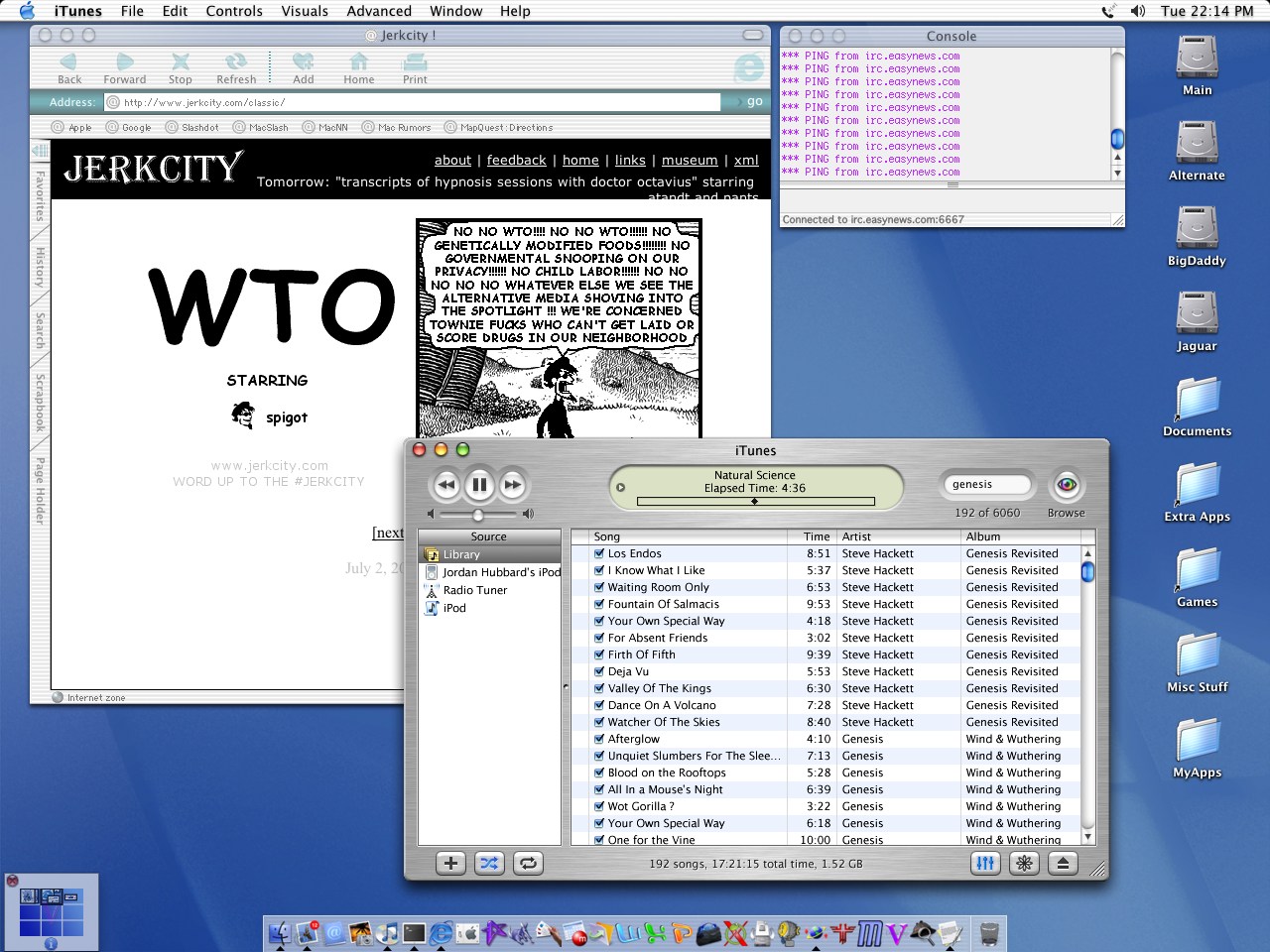
I completely misread '2015' as '2025' and thought these were from this November rather than November 10 years ago. I couldn't believe so many people were still using what appeared to be Aqua-era OS X.
Aqua-era OS X is the best looking out of the box desktop environment in the entire history of computing, and given 1) the lack of interest everyone seems to have in the desktop these days and 2) the directions in which the few remaining contenders are headed, I wouldn’t be surprised if it remained that way for a long time.
It’d be fun, as a side project, to build a pixel perfect replica of it (along with the core apps that make it useful) that runs on a modern Linux kernel and preserve it in amber forever.
RMS to me is really a curious case. He doesn't know how to install GNU+Linux and relies on others to do it. He doesn't know how to take a screenshot, and I remember reading other snippets from him about not knowing how to perform other basic tasks.
I once asked a YC alum, "Got any good Paul Graham stories?" And he had a couple; apparently the dude would often ask for help with basic tech things like setting up his wireless. Same kind of thing, I guess.
TBH with everchaning ifconfig/ip/systemd under GNU/Linux you almost forget that over years when your focused on Lisp or similar.
Under OpenBSD as the settngs are pretty much the same over releases, you can use ifconfig and /etc/hostname.if almost forever. That's it, upgrade and forget.
They are just old school. When you learn coding before GUIs were mainstream, you don't care that much about exciting UIs.
Heck, Kernighan was one of the original developers of Unix. In 2015 he was already coding for more than 40-50 years, more time than most from Hacker News are alive. The only constant from that time is the terminal, so no wonder most people in the post gravitate towards that
Coincidence? No, these are people for whom the computer is a tool. My smartest and most productive colleague run stock KDE and a more or less unconfigured Vim. He truly does not give a shit.
The more 'h4ck3r' screenshot you have with useless toys at /r/unixporn in Reddit, the less you actually know about computers.
Most i3 setups there are for showoff; cwm has better defaults and conmuting between
tags it's far more manageable than fighting with tiles where often the window resolutions are either useless or scramble your content.
Also most fluxbox or *box users will have far better setups than i3 ones because they use their actual setups to do actual stuff instead of posting screenshots.
Hard disagree. The fact that they have customized their system to such a degree shows they do know how to use computers. I think you're trying to conflate that with other things like programming ability, which are orthogonal.
I don't know why people take him so seriously. He said some decent things about software freedom, and the rest of his entire existence seems to be him being deliberately obtuse and generally off-putting. I find it bizarre that there's this strange carve-out here for him, especially considering that he would absolutely loathe 99% of the software that gets discussed here.
RMS is an extremist, and not the kind of person I tend to agree with, he seems to be a bit of an asshole too...
But that's also the kind of people we need. Companies are not going to compromise on their profits, we need someone to balance that and not compromise on software freedom. With these two extremes we can take an balanced position and that's how we got Linux and distros like Debian: it is free software, but it is also pragmatic. If we only had pure GNU (HURD), we wouldn't get far, but if we didn't have GNU at all, it would be even worse.
Richard Stallman didn't just talk. He actually wrote code, famously Emacs, and started the whole GNU project. I am not aware of recent technical contributions though.
I lived a year in a great hostel run by a German girl in Mexico.
She was always planning social events, hyping the place so that it was full of interesting people, and more. It was the most social part of my life even though I was 30.
But she also was frantic and obsessive and short tempered which was off putting.
Other guests would often complain about her, and they would phrase it as if she’d be cool if only she could turn down that one aspect about her. I had the same reaction at first too.
But eventually it became painfully obvious to me that that’s not how people work. Because the quirk you’re complaining about is the same quirk that got her to start a successful hostel across the world that we’re all enjoying.
We aren’t a bunch of independent levers that we get to adjust. Yet for some reason we pretend like that’s the case.
This is very well put. I appreciate him because I can't or rather I won't be like him. We need people like him and I will be the first to say "not it".
I think that sort of goes hand-in-hand. "Normal", well-rounded people don't decide that software licensing is the most important thing in the world and don't devote their entire life to that. A normal person would be content with a 9-to-5 software engineering job at Sun, IBM, or Microsoft.
I think you see that with a lot of other revolutionaries. They often take unreasonable positions and behave in unreasonable ways. RMS' tragedy is probably that his side more or less won, so now he's just a weirdo without a cause.
This puts me in mind of the words of George Bernard Shaw:
‘The reasonable man adapts himself to the world; the unreasonable man persists in trying to adapt the world to himself. Therefore all progress depends on the unreasonable man.'
And the world, people as a mob, will try its best to punish that person for daring to be different. The nail that sticks out gets beaten.
RMS is a flawed person, a stubborn unreasonable man with questionable traits. But dismissing his life's work as "said some decent things" is just ignorant revisionist history. We can acknowledge his flaws while respecting the work he did and the overall message, which changed the world for the better.
This couldn't be further from the truth. He has given several talks where he's projecting his computer, you can see him comfortably switching between all the programs he uses (Emacs, Mathematica, etc); in fact he is very efficient and has them customized just the way he wants it. (I even recall some blog post where the author watched one of these talks and was amazed by just wizardly he was navigating between programs or Emacs buffers or whatever.)
If you scroll down to the bottom of https://cs.stanford.edu/~knuth/programs.html you can see his configurations for Emacs and fvwm and even macOS keyboard layouts; some of them were updated as recently as this year.
> I designed my own bitmap font for use with Emacs, because I hate the way the ASCII apostrophe and the left open quote […] I prefer rxvt to xterm for terminal input. Since last December, I’ve been using a file backup system called backupfs, which meets my need beautifully […] Incidentally, with Linux I much prefer the keyboard focus that I can get with classic FVWM to the GNOME and KDE environments that other people seem to like better. To each their own.
Can you cite this in some way? Given he's shown the competence to write and typeset an impressive series of books, I find this claim pretty hard to believe.
Here is his fvwm rc. Given that it's fully documented, I will walk back my assumption that he can barely open a terminal. I researched it a bit and recalled an interview where he said something like "all I use X windows for is is to open a terminal in FVWM", so he clearly can customize it, but he prefers a minimalist setup.
FVWM setups can be really complex. Ditto with (c)twm. Once you are free to choose your windows geometry and keybindings, everything it's just either bloat or severely restricted.
It's been well known for awhile now that it's his preferred setup.
He seems to want as much stability as possible; while being as minimal as possible; with as little fuss to install and keep up to date as possible. Fedora meets those needs. Gnome is Fedora's main concentration.
Indeed. In fact, only recently the Fedora KDE version was elevated to "Edition" status and is now on the same tier as the Gnome version.
Most newer popular distros (Bazzite, CachyOS, Zorin, Asahi, etc.) default to KDE now, and it's very nice that Fedora's not only keeping up, but also providing the basis for some of them.
No worries. I started using Fedora around the 4-5 timeframe and am still using it 40 editions later -- time flies. To my memory, it's always been GNOME-first.
Which is weird, I've compiled and ran custom kernels and modules on debian before fedora 1.0 iso was announced on freenode/#fedora and it wasn't even good.
This is really fascinating, I would love to see a 2025 version from those willing to respond.
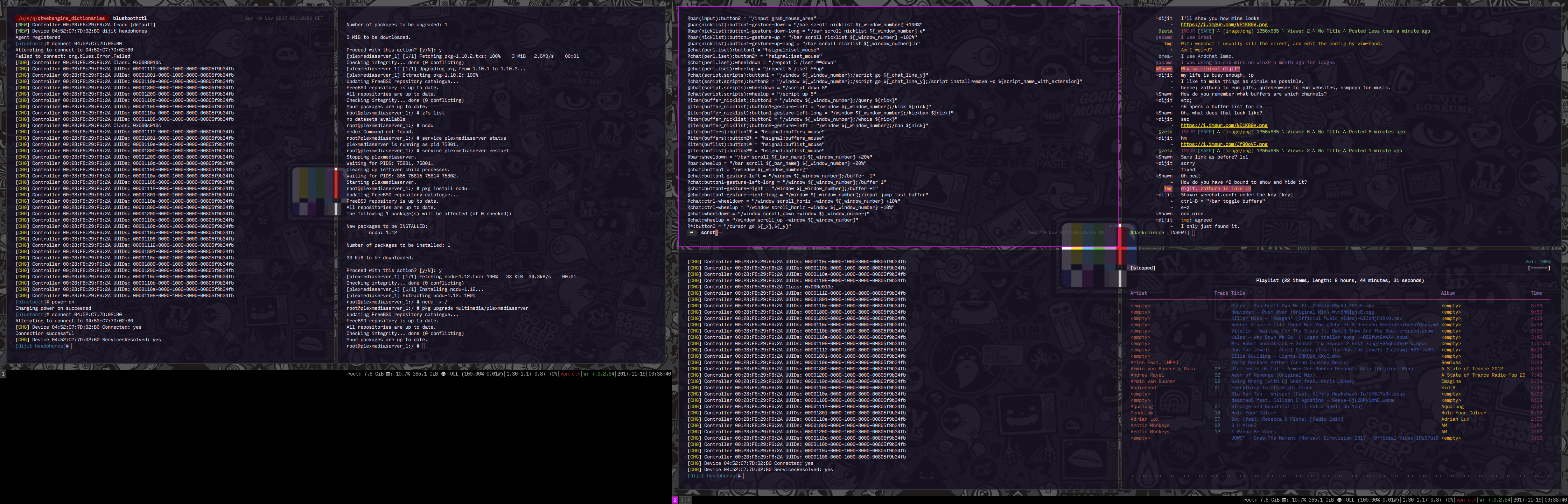
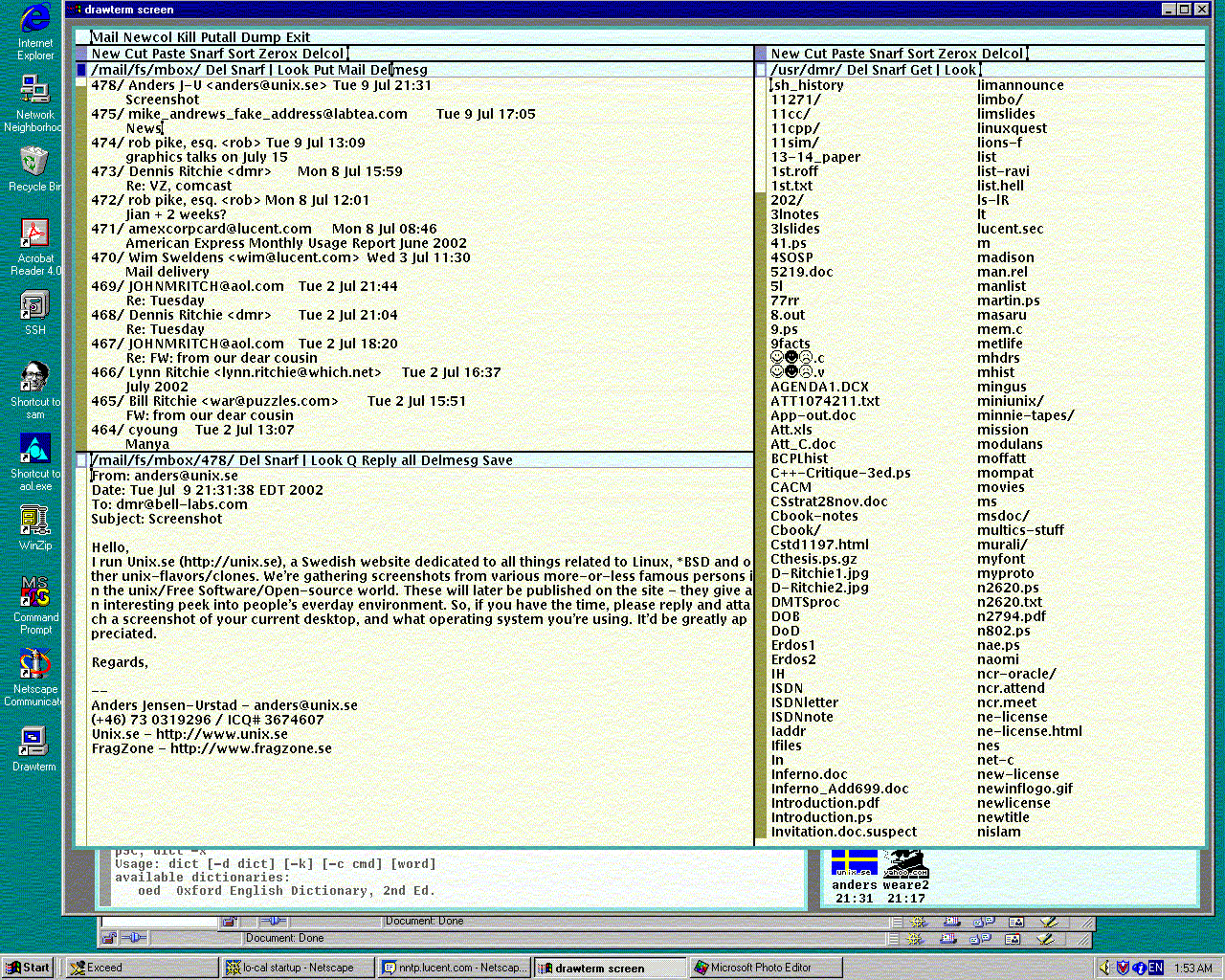
All of the screenshots strike me as "get things done". Little flourish, just windows and text mode apps where needed to finish the day's task. To me, an ideal to aspire to.
One thing I'm reflecting on here is just how boring these screen grabs are.
Even if I consider how my PC looked in 2002, the 2015 screenshots are far and away uglier than my desktop experience.
Yet... I produce... very little. At least when compared to these absolute titans, who have contributed much more to my computing experience than most - certainly more than myself, I find it somewhat unsettling.
It does seem like yesterday. Perception of time changes as one ages. We were settig up the Christmas decorations last weekend and I had an overwhelming feeling of "we just did this like a month ago" but it has already been another year.
About 15 years ago I tried xmonad, a tiling window manager, and I was hooked. I moved to awesome a few years later and that has been my desktop ever since. I still pretty much use only emacs, terminals, and a web browser in my daily work, and that goes back even further than my use of tiling window managers.
Mine is unchanged since I switched from DOS (Borland) to Windows (Visual C++/Visual Studio) development in 1995. If I sat 1995 me down in front of my PC it wouldn't take more than a couple of mins to figure everything out. He'd be confused about all the AI panes on the dev apps, though, I suspect.
(I've also never had a window tiled in my life; every window maximized at all times to avoid noise)
I remember those days, Fvwm2[1] was brilliant with its multiple screens and controlling the mouse using arrow keys - good times. Amazingly difficult to config even if you could get Xconfig to support your setup (external refresh rates and supported screen sizes and drivers for video cards).
But over the years I've come to appreciate the simplicity of Mac. Initially it didn't even have multiple screens but you could install (I forget the name) an application that simulated the multiple screens of Fvwm2. Right from the start I was glad for the simplicity of just having everything work or it wasn't supported - there was no in-between.
Today I'm using Spaces with iTerm2 and Emacs as core development tools. Not much different from my Fvwm2, xterm and Emacs in xterm solution from 25 years ago. Pity really that nothing has fundamentally changed in code development.
And that hasn't changed much since. At work and at home, I'm usually looking at emacs with no tab or menu bar, full screen on all monitors, with everything else (browser, etc) a virtual desktop switch away: exwm at home, one terminal emacsclient in ssh per monitor with a single daemon on linux server (accessed from Windows) at work. With many minor variations this is how my desktop has looked since my first programming job, which coincidentally was in 2002, but the details of the setup have changed a lot. The bit that has remained constant is that all I want on my monitor(s) when I'm programming is code.
Edit: Probably the most visible change is better fonts and font rendering.
Edit 2: To expand on "all I want is code": let's say there is a menu bar with maybe 10 menus and 100 or so items, and a project navigator thingy, and a compiler output window. I would much rather these things not take up permanent space on my screen. Every one of them shows information/commands that I can access with a key combination and in some cases some fuzzy completion after hitting a key combination. Any decent editor can do this and you can learn it in an afternoon, and if you're going to spend the next couple of decades in front of it it's worth getting rid of the pixels permanently allocated to advertising "you can do this thing".
I think I see only one truly tiled layout. But yes, "terminals and editors" as the core developer workflow is extremely conserved over time. It dates from the mid 80's on Sun 2's and really hasn't changed much in four decades.
It's probably not worth arguing whether this is the "best" when compared with vscode+LSP+Claude or whatever happens to be en vogue in the moment.
But terminals and editors is sticky in a way that tells me it's probably close to optimal. Those of us in the cult aren't observed to leave the compound except in extremely rare circumstances. I'll be doing the same stuff on my death bed, likely.
> But terminals and editors is sticky in a way that tells me it's probably close to optimal.
Optimal for those users, at any rate. IMO using a terminal editor is so painful compared to a decent GUI (Sublime or even VSCode) that I have a difficult time understanding why anyone would choose such a tool. I just try to repeat the mantra of "everyone likes different things" and stop trying to understand something where I likely never will get it.
Terminal editors generally do support the mouse, and there are occasions where even a fairly skilled user of a good terminal editor will find it easier to click to set an insertion point than use commands to reach it. But having those key-command options greatly enhances the experience. You need to watch the screen while a skilled user edits text to get it. It's like magic.
I haven't picked up nearly as much as I'd like, but even basics (requiring zero config) are way beyond what I could easily do in any GUI editor I ever experienced. For example, in vim, if you are on a bracket or parenthesis (open or close) in edit mode, it is three keystrokes to delete the entire bracketed portion, precisely, regardless of size (even if the matching bracket is off screen). Finding the matching bracket with the mouse is often hell.
And it's not as hard to learn as you may expect, because those keystrokes are not magic codes; they're part of a consistent, thoughtfully designed command language. You choose a mode for selecting text (character based, with lowercase v), use "motions" to select the text in that mode (in this case, a single "go to the matching bracket" motion, which is the percent sign), and take an action with that selection (delete it, with d).
I wonder if there's a worthwhile time-saving in aggregate? To me it seems like overall the bottleneck is always thinking what code to write/edit, not the actual edition. So I'm not convinced shaving a couple seconds here and there outweighs the benefit of a modern IDE or offsets the time spent ricing such a setup.
It's not mainly about speed (although the ceiling is much higher), but about ergonomics, and, plainly, enjoyability. The other benefit of making your own environment is mastery and control; only you can decide when and how the environment changes.
> To me it seems like overall the bottleneck is always thinking what code to write/edit
I feel the same way. But small advantages compound to at least some extent (see e.g. https://danluu.com/productivity-velocity/); and I find that noticing that it takes more time than I'd like to write/edit something, risks breaking my flow.
Seems like the opposite to me. IDE fashion changes like the wind. "Normal developers" are constantly starting over with new tools and new paradigms every time they start work on a new project. Gotta have the right vscode extensions to flash your firmware, IT only supports IntelliJ on the new job, ad infinitum. It's been this way for decades.
My .emacs file gets updated regularly, sure, but it's thirty years old, and my basic flow hasn't changed.
Take about anything from a standard GUI editor. In a terminal editor, they are also easily accessible. And more easily accessible (if not discoverable). But one of the major gain is how close your shell is. A lot of editors allows to start a cli tool and optionally send a portion of the current buffer as input to it. You may also be able to include the output in some buffer too. Some GUI editors allows that, but it's almost always a config maze and you're never sure of the environment in which it does run the commands.
Also in a terminal environment, all you enter are keyboard keys. If you know how to touch-type, your cognitive load can be greatly reduced (personal feeling). You can also navigate something like sublime with keyboard only. But it's way more tiresome.
For me its how easy it is to extend. Kakoune makes it so easy to integrate with the rest of my system. I can often create any kind of integration I need with just 1-10 lines of code. In vscode I need to just hope that someone else built the integration I need as a plugin, because writing plugins is really painful.
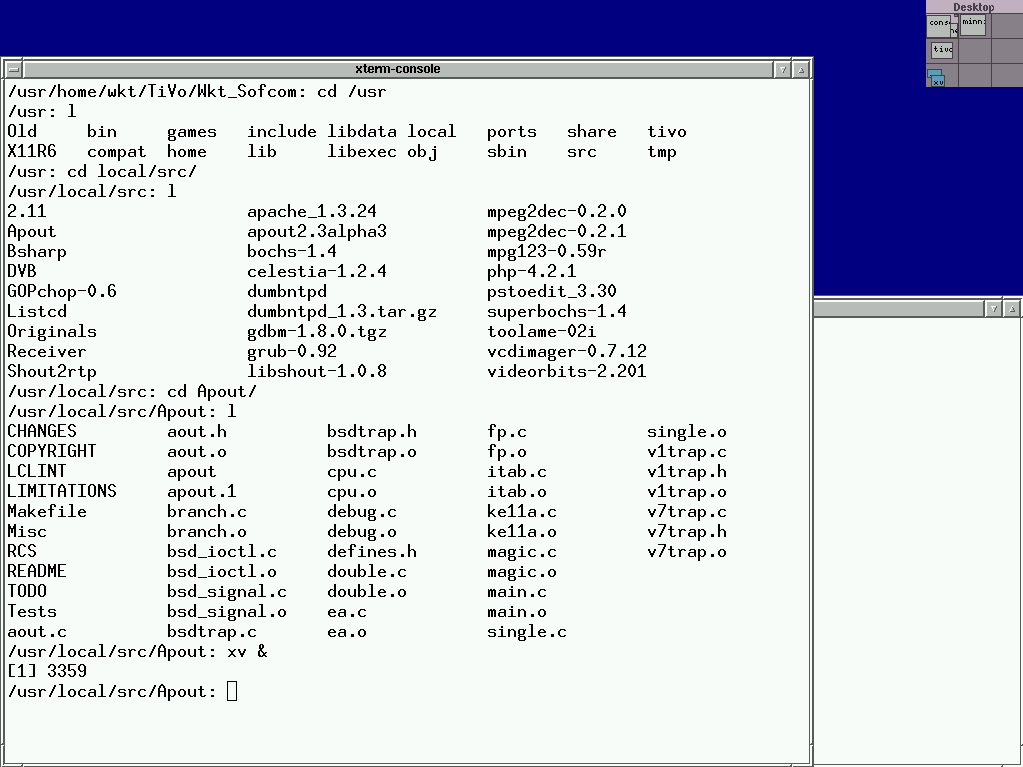
Hey this one over here [1] has a virtual desktop minimap on the top right. That person mentions fvwm which has this [2] website with screenshots, but I don't see the minimap there. Could someone help me find a reference to it?
Jordan's the rapscallion who scribbled all over Dennis G. Perry's Interleaf windows (program manager of the Arpanet in the Information Science and Technology Office of DARPA) with his infamous global rwall on March 31, 1987.
Milo Medin said "Dennis was absolutely livid, and I recall him saying something about shutting off UCB's PSN ports if this happened again."
    From: Milo S. Medin <medin@orion.arpa>
    Date: Apr 6, 1987, 5:06 AM

    Actually, Dennis Perry is the head of DARPA/IPTO, not a pencil pusher
    in the IG's office.  IPTO is the part of DARPA that deals with all
    CS issues (including funding for ARPANET, BSD, MACH, SDINET, etc...).
    Calling him part of the IG's office on the TCP/IP list probably didn't
    win you any favors.  Coincidentally I was at a meeting at the Pentagon
    last Thursday that Dennis was at, along with Mike Corrigan (the man
    at DoD/OSD responsible for all of DDN), and a couple other such types
    discussing Internet management issues, when your little incident
    came up.  Dennis was absolutely livid, and I recall him saying something
    about shutting off UCB's PSN ports if this happened again.  There were
    also reports about the DCA management types really putting on the heat
    about turning on Mailbridge filtering now and not after the buttergates
    are deployed.  I don't know if Mike St. Johns and company can hold them
    off much longer.  Sigh...  Mike Corrigan mentioned that this was the sort
    of thing that gets networks shut off.  You really pissed off the wrong
    people with this move!

    Dennis also called up some VP at SUN and demanded this hole
    be patched in the next release.  People generally pay attention
    to such people.

                                            Milo
Interesting how Brian works. I guess it is the UNIX spirit
he carries there. Or perhaps he is damn fast with the tabbed
WM. Or is that OSX?
I use mostly IceWM these days. I can't use the leaner WMs such
as ion or ratpoison and XFCE, mate-desktop, KDE and GNOME are
too slow or too crap (KDE unfortunately also now; before that
only GNOME was crap. KDE killing xorg-support also means it
is one less thing I can use anyway.)


reply