If the residency restrictions were removed the labor market would work as intended. We’re doing this to ourselves to protect private profits at the expense of people’s lives.
I think you fundamentally misunderstood any aspect of society, civility and community building if you adhere to such ideas. The issue at hand is bad governance and resource management, not that “immigrants should be kept out”.
Immigration is needed at different parts of a country’s economic timeline, and the levels of immigration needed can vary depending on your needs to balance labor supply and demand. This isn’t about racism, or cultural differences. This is about good governance.
Doctors with proper training will do what they were trained for. Maybe personality traits play a role as well secondary, but stuff like culture is just noise compared to what really matters.
Maybe lol? There is basically no way of knowing cost going into anything or whether or not it will wind up being covered. Also when they get around to demanding money they won't necessarily do it all at once, you can get a bill a year after a visit even though they billed you the first time 4 months ago or some shit. A doctors office can handle this well with significant effort on their part or not.
We won't train any more doctors - there's a cap on the number of funded residency slots in the US (as lobbied for by the AMA back during the Clinton admin, IIRC). Hospitals have little to gain by self-funding slots (assuming that's even allowed).
> I want a doctor who feels some blood and soil attachment to their patients.
"Blood and soil (German: Blut und Boden) is a nationalist phrase and concept of a racially defined national body ("Blood") united with a settlement area ("Soil"). Originating in the German völkisch movement, it was used extensively by Nazi Germany, ...
North American white supremacists, white nationalists, Neo-Nazis and members of the alt-right have adopted the slogan. It gained widespread public prominence as a result of the August 2017 Unite the Right rally in Charlottesville, Virginia, when participants carrying torches marched on the University of Virginia campus on the night of 11 August 2017 and were recorded chanting the slogan, among others."
I never said you were a Nazi. The Nazi party hasn't been active since 1945, in small part because of my grandfather's military service fighting fascism in Europe. I trust you respect his service and that of millions of other soldiers and civilians by also being against fascism.
Are you willing to define your culture?
Does your culture include Catholics? JFK famously was accused of being a papist, and Prohibition was in no small part due to xenophobia about Catholic immigrants to the US, who didn't share "our" culture.
What about Catholics who send their kids to Catholic school instead of public school? Mormons who do the same? Does it include Amish who speak their own German dialect, with their own religion, parochial schools, and culture?
What about atheists? Homosexuals? Trans people?
Does it include the children of Cuban refugees who grew up in the Little Havana part of Miami, with Spanish as their first language? Who celebrate Nochebuena and quinceañeras instead of Christmas Day and Sweet 16s?
Does it include native Spanish speaking New Mexicans whose family has lived in the state since Imperial Spain colonized Nuevo Mexico in the 1600s?
Does it include Native Americans? Would you shy away from medical care from a Native American physician? Would you prefer to not work with a Native Hawaiian?
Is your definition of "culture" simply "born in the US"? Does it include people from American Samoa? Puerto Rico? Guam?
Does it include people with US citizenship who have never lived in the US?
Does it include someone from Canada? Does it include someone from a Canadian First Nation?
I think you see how simply saying "your culture" doesn't really make sense given that the US - and I think nearly all countries - contain a multitude of cultures.
I suppose they could expand medical school admissions for Americans, why don’t they? It’s not for lack of talented people, the class size quotas are an archaic classist and partly racist way of thinking that have nothing to do with meritocracy, but instead are imposed to make sure that more undesirables don’t join the “elites” of society.
Some quick Googling surfaces the number of residency slots as being another limiting factor to medical school admissions. Apparently, federal funding caps the maximum number of residency slots which creates a bottleneck in the system.
It's most likely the case that there are multiple different bottlenecks. It's not just 1 person in a room somewhere saying "we need to make protect the elite!" - it's more likely just a lot of people continuing the status quo and few people fighting the change it.
The AMA pushed for limited residency slots ~20 years ago, as they feared too many doctors would cut their own incomes.
For some reason, residencies are paid by the federal government. Not sure of the history there - I find it hard to believe a resident doctor is a net-loss for the hospital system. Either way, I can't find any legal cap on number of residents - only a cap on funded slots (ie, a hospital could hire more residents and pay them out of pocket).
That might be true, but at the same time, do we really want doctors who haven't completed some form of apprenticeship? The hours/shift were sliced in 2003 and again in 2011. Though they're still much higher than what's normal in the EU.
What I can't quite figure out is patient outcomes... morbidity appears to have increased (very slightly) as resident working hours were reduced (possibly more risk from handoffs than tired MDs?) - how does the EU compare in this regard? Somebody must have done a study...
Anyway, some form of on-the-job training seems reasonable here. But the current residency system in the US definitely appears broken, for several reasons.
I think the issue is US _culture_, not education (although the two are intertwined). We had too many easy years where you could take a Jack Kerouac road trip for 5 years to find yourself and then settle down to the equivalent of a cushy 6 figure job just for being a man with a pulse. Now if you do that, you will come back to find all the cushy jobs filled, and you are unqualified for anything except bottom of barrel service industry jobs.
Today there is a lot more prerequisite grind to become a doctor that parents don't feel good about forcing on their kids. Five decades of movies villifying parents for pushing their kids too hard will do that.
Meanwhile, parents in/from China and India and Nigeria and many other places are more than willing to force their kids to grind to move up the economic ladder.
At our current level of technological advancement, we should be able to get far more than a 5y Kerouac road trip before joining the grind. Where are all those supposed productivity gains going? Why are we becoming less free?
(This is sort of an aside. Yes, bring all the hardworking immigrants here, please. And maybe let them have those road trips, too.)
It's obvious to me the gains of our productivity is being siphoned up. The US economy is... very weird right now, and has been getting weird for a few decades. I wouldn't even consider the US a capitalist nation, what we have is something new.
Most companies don't do anything, most investors make money without putting in any labor, and money just... poof, appears. But not for us. Nothing really seems to make sense anymore.
Things that were trivial before, like having a receptionist to answer your phone, now seems economically impossible. And yet, our GDP continues to rise. We run companies with a tenth of the people we did before - everything is computerized, automated. But the wages are lower.
- stonks go up to prevent a pensioner revolt and to inflate egos of billionaires
We are kind of equivocating about "the grind" though. There is the grind of a student keeping their heads in books and activities while friends play video games or party or whatever. This grind has a light at the end of the tunnel in the form of obvious graduation dates and similar rites of passage.
Then there is the grind of working at McDonalds or Walmart because that is the only opportunity left to you, and that is a grind that might easily go on forever unless you win the hunger games and get into a management track rat race.
Getting into the medical school and staying there for so many years until you can support yourself means also a huge investment from the family. Now, what is the culture saying about this? Would you keep your kids on your paycheck until they're almost 30, or you throw them out to get a job as soon they're 16? And of course, can the kids already afford to be independent and support themselves when they're 16 (aah sweet liberty fuck those geezers)? These are I believe other major contributing factors in western societies.
I know this is a rhetorical question, but... yes? As a parent I absolutely am going to make sacrifices to help my kids get through college, and one is planning for med school. I feel like many immigrant parents have this mentality. It is the native born who do not. (Native born white guy here looking at all my family and acquaintances)
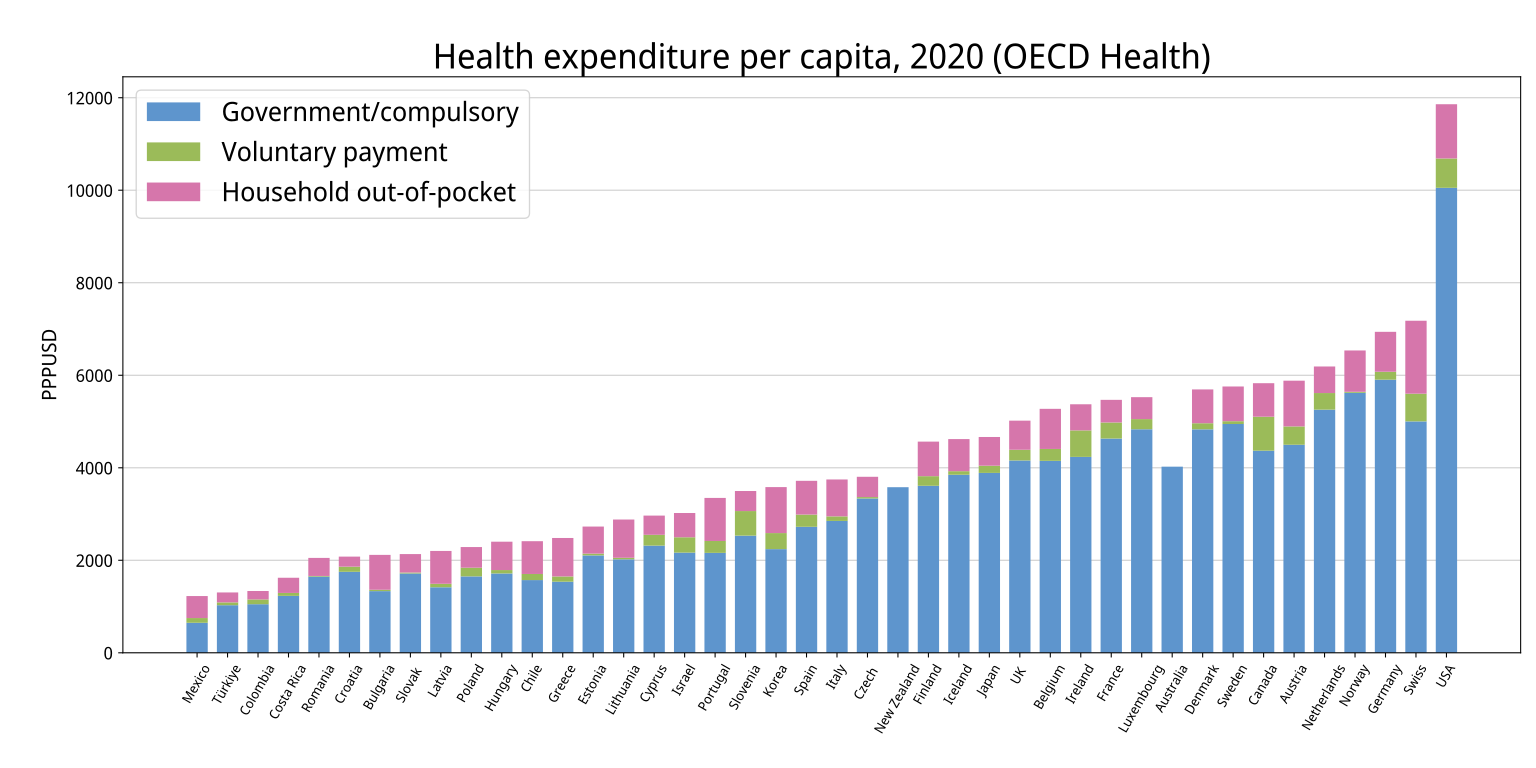
US health care continues to fall behind other Industrial Countries.
Can you provide evidence of this? The services are top notch, and over 90% of people have health insurance. Moreover, in other single payer systems (Canada, Poland) I keep hearing about months long wait for procedures until you go private/out-of-pocket.
The unique thing about the US healthcare system is that care is directly proportional to how much money you can spend on it. So as a top spender, yes the care is great. Though realistically we should look at the system as a whole for all people it "covers". Looking at infant mortality rate, life expectancy, etc, for the average person, the picture is bleak; the US is shockingly bad.
Exactly. The data tells the story, and the results data of healthcare in America is abysmal. I used to workout at a gym that was near a major hospital. I will never forget a conversation I overheard between two doctors in the steam room many, many years ago where they were talking about this issue and the one doctor quipped to the other "the United States has the best healthcare nobody can afford."
Having insurance in the US doesn't mean anything, as the insurance itself does not provide any health care.
In fact they actively try to provide as little care as possible. It's a negative signal, not a positive one as you seem to think.
> The services are top notch
Healthcare is a plethora of services, ranging from something as simple as a blood draw to open-heart surgery. I can tell you from experience that many diagnostic services are definitely NOT top notch, and the service of getting billed after is an absolute nightmare.
Sorry, but as an outsider from one of those other countries you mention, I don't get what you mean by top notch? Top notch for whom? The people who can afford to pay out of pocket? Or those willing to do into debt to just get treatment? Whenever I see news from places like PBS News Hour, it's about some low wage or senior person struggling to just care for their medical needs or prescriptions.
I don't know my guy, your system isn't exactly top notch for most people - I don't think you need to look very hard to see that if you try.
WTF are you on about? There's a cap on the number of funded residencies (the federal government pays those salaries). Nothing to do with education. Everything to do with the AMA begging Congress to cap those positions ~20 years ago to protect their incomes.
The article states rural areas tend to be served by a higher proportion of immigrant doctors. The densely populated coasts will probably be fine - the higher salaries will continue to attract US-born and limited immigrant doctors.
$200k urban vs $205k rural median offers to new doctors overall. But, in surgical practices, that flips well in favor of urban offers. But, that's just for new MDs. Career numbers skew even more to rural doctors
>The article states rural areas tend to be served by a higher proportion of immigrant doctors. The densely populated coasts will probably be fine - the higher salaries will continue to attract US-born and limited immigrant doctors.
I had only anecdotal knowledge(I know Canadian doctors are all going to the big cities) and I looked it up before posting for who would be most impacted.
You are correct the article tried to suggest rural, but fact check false. It's easy to see why NPR did this.
NPR represents urban liberals; their readers won't like reading that their healthcare costs are about to go way up.



https://www.openhealthpolicy.com/p/medical-residency-slots-c...
reply